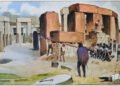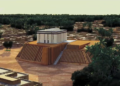
The land between the rivers Tigris and Euphrates, Mesopotamia, delivered some fine erotic art. Mesopotamian erotica was “really something racy,” Laura A. Peri, curator of Western Asiatic Antiquities of the Israel Museum in Jerusalem, said. “It’s not all, you know, missionary and that’s it.”
Terra Cotta plaques
They had fun. The plaque shows a man penetrating a woman from behind with the woman drinking beer through a straw from a jug.
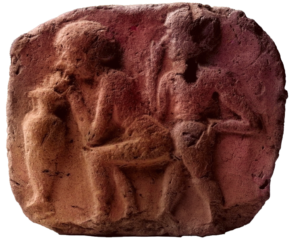
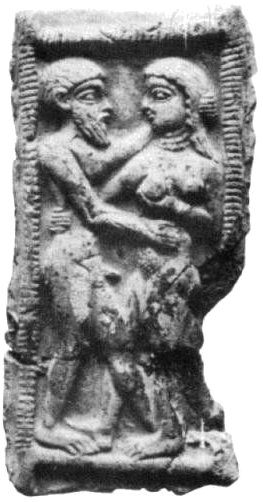
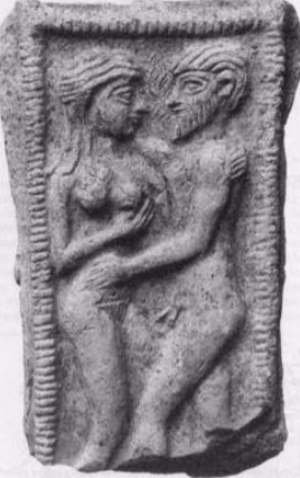
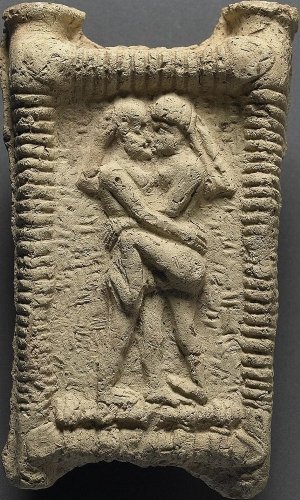
Sexual intercourse between a woman and a man on a terra cotta plaque from Babylonia, early 2nd millennium BCE (photo credit: The Israel Museum, Jerusalem)
It is small enough to hold in your palm and depict a couple copulating in remarkable detail. Dating from the early second millennium BCE in Babylon, they come from a 300-year window when mass-produced terra cotta plaques were popular, including those that exhibit sexual acts.
The terra cotta plaques from Mesopotamia yield numerous different sexual positions, but one of the most popular was what’s referred to technically by the Latin: coitus a tergo — from behind. Other plaques show partners side-by-side, standing up (aka lleváme) and plain old missionary; some depict women with legs spread, squatting over a comically large phallus.
“It’s a kind of pop art, because it’s very cheap material and easy to make,” curator Peri said. She explained that sexuality was very prominent in ancient Sumerian and Babylonian art and literature, particularly in the late-third and early-second millennia. Cylinder seals — small cylinder-shaped stones etched with figures and cuneiform used as a signet — occasionally featured men and women in erotic poses. Peri, an expert in understanding the symbolism of the seals, noted that erotic scenes usually weren’t the central image, nor did those seals belong to the king or officials.
Israelite and Canaanite artwork, by comparison, typically had very little overt sexuality, only nude female figures that disappeared after the institutionalization of early Judaism in the eighth century BCE. (A mid-second millennium BCE Canaanite scarab seal found at Tel el-Far’a.)
A stark difference, however, was the difference in ancient Babylonian and Israelite perspectives on male homosexuality. The Babylonians, writes Prof. Karen Rhea Nemet-Nejat in her book Daily Life in Ancient Mesopotamia, “didn’t condemn this practice” and observed a live-and-let-live attitude in regard to male-male sex. The Book of Leviticus, on the other hand, bans lying “with mankind, as with womankind” as “an abomination.”
Dr. Ilan Peled of The Hebrew University said there’s a scholarly debate over what purpose the erotic art served, with some contending they were votive objects for the veneration of Ishtar, the love goddess. Assante argues they were apotropaic, like other terra cotta amulets from the era, meant to keep away evil spirits. Others say that the clay plaques “portrayed prostitution, sexual relations conducted within a tavern, or sexual intercourse between a husband and wife,” with no particular context.
“It is possible that we merely face here a very early version of Playboy, Middle-Eastern style,” Peled said.
THE EPIC OF GILGAMESH
The Epic of Gilgamesh, Mesopotamia’s great literary work, lauds sex as one of the carnal pleasures humans ought to indulge in during our brief tenure on this planet. Siduri, a divine alewife, tells the eponymous king of Uruk to “let your belly be full, your clothes clean, your body and head washed; enjoy yourself day and night, dance, sing and have fun; look upon the child who holds your hand, and let your wife delight in your lap! This is the destiny of mortals.”
‘And let your wife delight in your lap…’
Peri explained that “delight in your lap” was a common euphemism for sex in ancient Akkadian.
The Epic of Gilgamesh personifies the evolution of modern man, bringing to light on the development of humankind it took to reach Mesopotamian civilization.
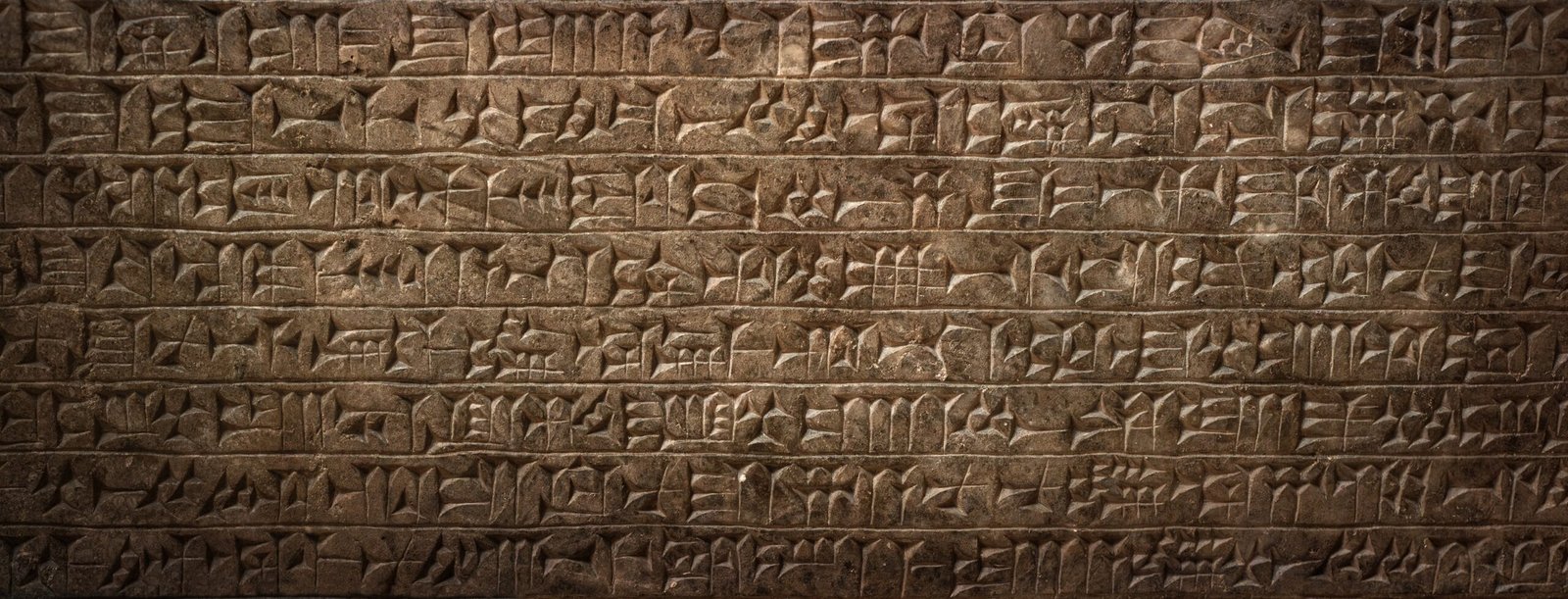
Tablet 1. T H E T A M I N G O F M A N, the Coming of Enkidu
Arrogant King Gilgamesh tyrannizes the people of Uruk, who complain to the gods. To divert his superhuman energies the gods create his counterpart, the wild man Enkidu, who is brought up by the animals of the wild. Enkidu is spotted by a trapper, who lures him away from the herd with the temple harlot Šamḫat. Šamḫat must tame the wild man by seducing him and showing him her arts:

The passage from the “Epic of Gilgamesh” about the taming of Gilgamesh’s friend Enkidu goes:
(Then) Šamḫat saw him, the savage-man,
a murderous fellow from the midst of the wild.
‘This is he, Šamḫat! Uncradle your bosom;
bare your sex so he may take in your charms!
Do not show fear, take in his scent!
He will see you and he will come up to you.
Spread your clothing so he may lie on you,
treat the man to the work of a woman!
his herd will be estranged from him, though he grew up in its presence.
His ‘love’ will caress and embrace you,
Šamḫat let loose her skirts,
she bared her sex and he took in her charms.
She showed no fear, she took in his scent:
she spread her clothing and he lay upon her.
She treated the man to the work of a woman,
his ‘love’ caressed and embraced her.
For six days and seven nights Enkidu, erect, did couple with Šamḫat.
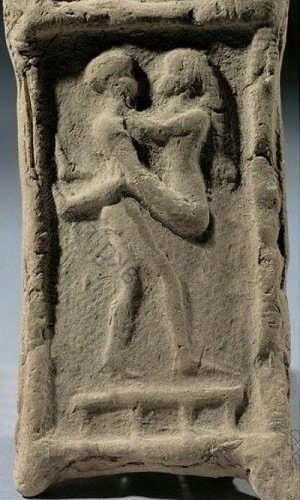
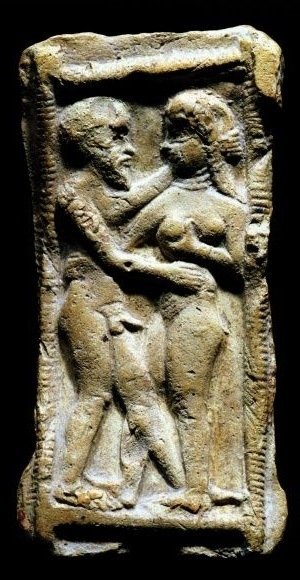
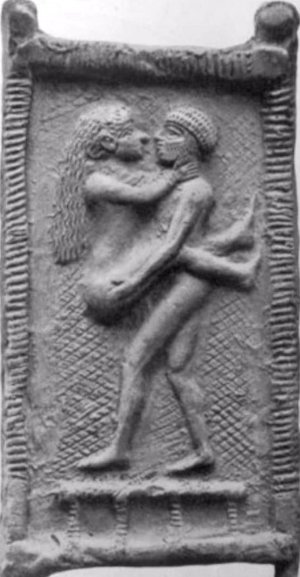
Day 7 was a rest day.
Day 1
Day 2
Day 3
Day 4
Day 5
Day 6
Day 7
Now he was no longer a savage, but a man.
Sources:
- Iraq Museum, Baghdad.
- timesofisrael.com/4000-year-old-erotica-depicts-a-strikingly-racy-ancient-sexuality/amp/
- THE EPIC OF GILGAMESH: Translated and with an introduction by ANDREW GEORGE, PENGUIN BOOKS 1999.
- The Israel Museum, Jerusalem.