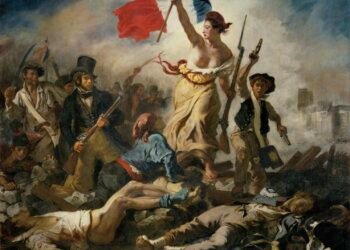
Art depicts scenes that prompt an emotional response.
Painting, literature, music, dance, and theater have existed for thousands of years, but cinema was invented only recently by the French brothers Louis and Auguste Lumière on December 28, 1895, when the world’s first commercial movie screening took place at the Grand Café in Paris.
Art/Entertainment often depicts objects or scenes of homo sapiens’ social conditions, social order, mythology, and other fantasy stories. Art started in prehistory with depictions on Cave walls.
Prehistory
Prehistoric art is the earliest human creative expression, made before writing (before -3,400 in Mesopotamia), encompassing cave paintings, figurine sculptures, engravings, and early architecture. It showcases depictions of animals and humans, exploring themes of survival, ritual, and cult. Art provides crucial insight into the origins of human emotional being, their condition, and the social order that evolved through the Old Stone Age (Paleolithic), New Stone Age (Neolithic), Metal, and Modern (post-American/French Revolution) periods.
The Lascaux cave. Source: https://archeologie.culture.gouv.fr/en
© Ministère de la Culture/Centre National de la Préhistoire/Norbert Aujoulat
Major Periods & Examples
- Old Stone Age (Paleolithic): Longest period, known for cave art and portable sculptures.
- Lascaux & Chauvet Caves (France): Magnificent animal paintings, sometimes over 30,000 years old.Venus of Willendorf (Austria): Iconic small female figurine, -27,000, likely fertility symbol.
- Bhimbetka (India), Borneo (Indonesia): Extremely ancient rock art, some figurative paintings over 40,000 years old.
- New Stone Age (Neolithic): Art becomes more common, reflecting settled agricultural life (pottery, megaliths).
In this article, we focus on the two basic areas of choice and control in art: form and style.
Form is the overall patterning, the ways its parts work together to create specific effects.
Style involves the use of techniques.
Stories
Stories present a pattern of events that create suspense or surprise. The story asks us to feel an emotional response to the pattern we help create.
- Our brain is very good at finding patterns in things—emotions in faces, a rhythm in a soundtrack. Artworks rely on this dynamic, unifying effort of the human brain.
- Forces that appear in scenes, we expect to see them again later on and would be disappointed if they didn’t reappear.
- Alongside the story, we also notice stylistic elements: In film art, styles are implemented through the way the camera moves, the use of music to set an emotion or emphasize story points, and other devices.
Expectations
A story develops expectations and maintains them throughout its scenes.
In viewing a mystery, we expect that a solution will be offered at some point, usually at the end. In listening to a piece of music, we expect repetition of a melody or a motif. From beginning to end, our involvement with a work depends largely on expectations.
A little brain game.
Assume that “A” is the first letter of a series. What follows?
AB
After seeing A, you probably expected the next letters to follow alphabetical order. Your expectation was confirmed. What follows AB? Most people would say “C.” But form doesn’t always follow our initial expectation.
ABA
Here, the form takes us a little by surprise. If we are puzzled by a formal twist, we readjust our expectations. and try again. What follows ABA?
ABAC
Here, the main possibilities were either ABAB or ABAC. Note that your expectations both limit possibilities and select them. If you expected ABAC, your expectation was fulfilled, and you can confidently predict the next letter. If you expected ABAB, you should still be able to make a strong guess at the next letter:
ABACA
Simple as this game is, it illustrates the compelling power of form. As a viewer or listener, you engage actively with it, creating and adjusting expectations as the pattern develops over time.
If you’re a storyteller, you arouse and shape viewers’ expectations.
Expectations may also be disappointed, as when we expect ABC but get ABA. In general, surprise results from an expectation that is revealed to be incorrect.
The storytellers can cue us to form expectations and then gratify them. The expectations may be gratified quickly, or the storyteller may wait quite a while before fulfilling them. And the storyteller may set up expectations and then undercut them, creating surprise.
This little game of guessing the next token also forms the basis for how trained LLMs (Large language models) in AI (artificial intelligence) operate.
Principles of Form
Form is not a formula. Newton discovered powerful laws governing the physical world, but in the arts, there are no form laws the artist must follow. Use them and play with them at will or use them by convention.
Form and Feeling
Often, form in artworks appeals to our preexisting emotional responses.
Similarity and Repetition
In our example of the ABACA pattern, we saw how we could predict the next steps in the series. One reason was the regular repetition of elements. Like beats in music, the repeated A’s in our pattern established and satisfied formal expectations. Similarity and repetition, then, constitute an important principle of story form.
Motif
- A motif is any significant repeated element that contributes to the overall form. It may be an object, emotion, colour, place, person, sound, musical theme, or even a character trait.
- Motifs often reappear at climaxes or highly emotional moments.
- Motifs are fairly exact repetitions, but a story can chart broader similarities among its ingredients.
Stories
- Much of what happens in stories is governed by conventions.
- A very old storytelling convention: prepare the audience for action that will return later.
- A satirical comedy follows the convention of using exaggeration to create humor.
- Parallels cue us to compare two or more distinct elements by highlighting a similarity.
- Motifs can help create parallels among characters and situations.
Difference and Variation
A storyteller is unlikely to rely only on repetitions. AAAAAA is mostly totally boring.
There should also be some changes, or variations, however small. So difference, or variation, is another fundamental principle of story form.
Development
One way to see how similarity and difference operate in form is to look for principles of development from part to part. Development places similar and different elements within a pattern of change.
Our pattern ABACA is based not only on repetition (the recurring motif of A) and difference (the insertion of B and C) but also on a principle of progression that we could state as a rule:
Alternate A with successive letters in alphabetical order. Though simple, this is a principle of development that governs the form of the whole series.
Storytellers often treat formal development as a progression moving from beginning through middle to end.
Development can happen in many ways.
- A journey. Storytellers often build their plots around journeys.
- It can also be a search. In the story, there’s often a pattern of mystery that follows the same beginning-middle-end structure.
- We begin with a dramatic question, pass through attempts to answer it, and conclude with the question answered.
- You see stories that combine the patterns of journey, search, and mystery, adding the psychological change that occurs in the protagonist. Lengthy stories often depend on several developmental patterns.
- A story consists of connected sequences/chapters. Each sequence is formed by a complete, developed story arc (plot and subplots) with a beginning, middle, and end.
This outlines the pattern of the story’s development. When we create or analyze a finished story, we do the same by producing a segmentation. A segmentation is a written outline that divides the story into its main and minor sections (such as acts, sequences/chapters, and scenes), marking each with consecutive numbers or letters. For example, a story with 50 scenes can have each labeled from 1 to 50, and some parts may be further subdivided. Segmenting a story helps us identify similarities and differences among its parts and allows us to map its overall progression.
Further reading: David Bordwell Kristin Thompson Jeff Smith, FILM ART An Introduction, Thirteenth Edition 2024.