
Consciousness isn’t a direct live feed. It is a reconstructive process of memory integration, prediction, and synchronization of the different senses to build a unified world.
The human brain consist of 100 billion neurons, each neuron connected to 10,000 other neurons.1
The brain has massive interconnectivity, the heart of which is the thalamus connecting virtually every region of the outer cortex with the thalamus and other cortical and subcortical regions. Most neural pathways are bidirectional so the thalamus-cortical circuitry connects almost every region of the cortex to the thalamus and back.
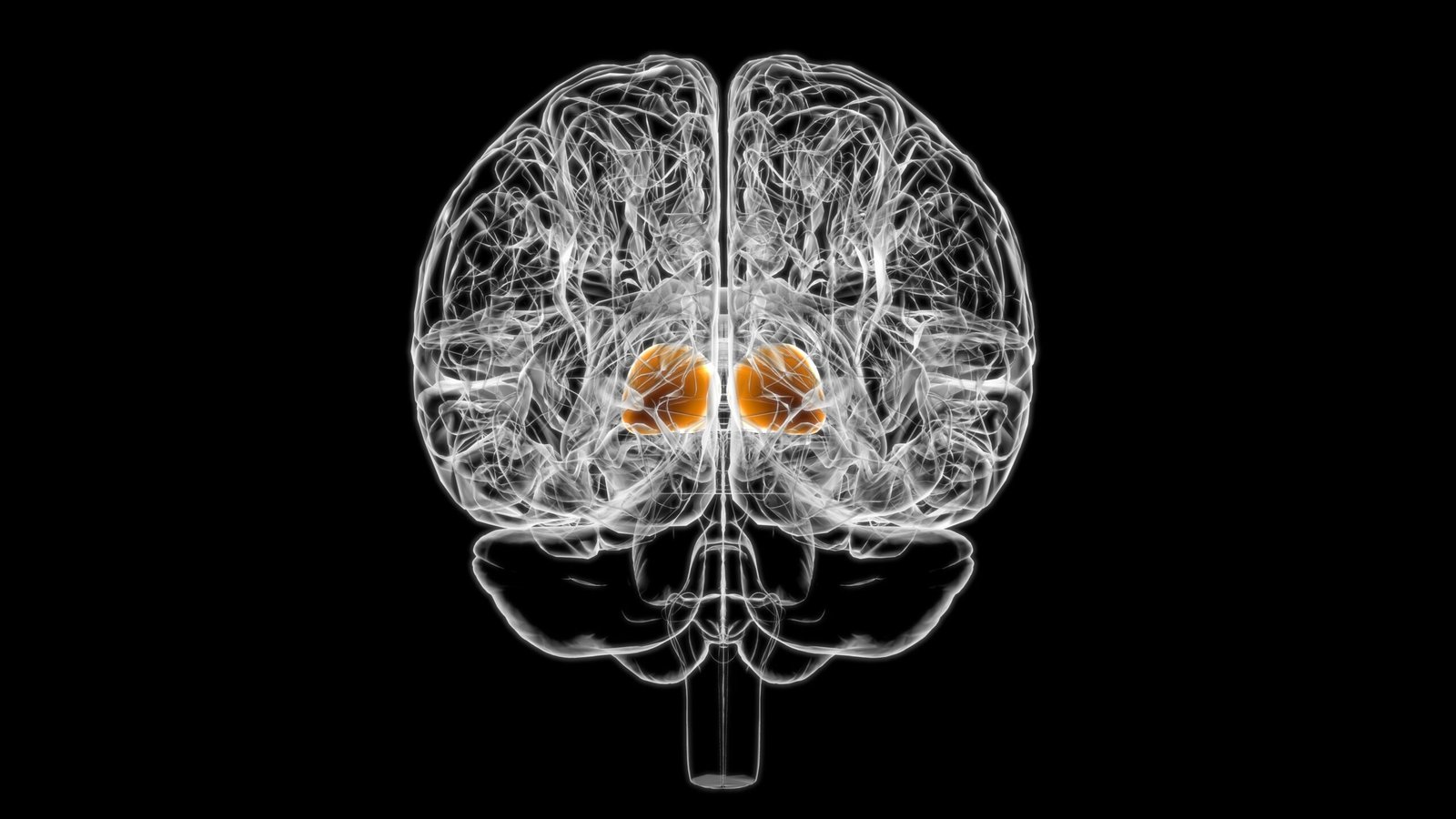
A key aspect of brain function is clarify how these many bidirectional pathways form our mind/brain, with an integrated sense of awareness of our world around us, our inner thoughts, and our very consciousness.
Our Consciousness
Consciousness is the water in which we swim. The contents of our consciousness form the base of our awareness. Fluid, flexible, ever-changing contents of our consciousness seem to be a vast sea in which we swim.



Experimentation has time and time again proven this thought to be false!
Consciousness is the flow from current awareness, to memories of the past, to predictions of the future. The contents of our consciousness are quite limited. At any given time, our brain filters most out of consciousness to keep us focused.
When we concentrate, we filter out all the signals that distract us from the task we are currently performing in our consciousness. This allows us to use all our conscious cognitive functions for the task at hand.


It is our unconscious processing that forms the overwhelming majority of our brain functions.
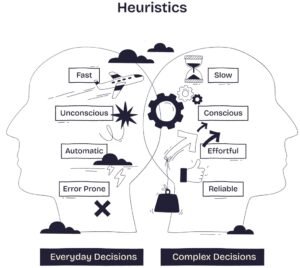
But there is a problem. That same filtering also limits us.

Our brain takes in information through our senses and experience this as what we think is reality. But this reality is biased and incomplete. It’s processed, filtered, and formed by our past experiences, knowledge and beliefs. We make interpretations of events that are filtered through our personal history.
The filtering creates problems when it is used as a defense to block unwelcome information.
This filtered reality serves a purpose. It makes us feel safer. But it also gives us blind spots by these limiting defenses mechanisms and false beliefs.
The mind perceive, filters, and selectively remember the enormous amounts of information that originate both inside and outside the mind. Only a small part is conscious, the rest is processed automatically and unconsciously.
This filtering and processing of information is organized in such a way that individuals think, feel and act as one. The brain provides mental functions that are used by our skills. The strength or weakness in the mental functions varies per individual and can change over time.
Neural Pathways and our Functional Areas
The brain has major pathways and maplike arrays of neurons that use single spikes (action potentials) as well as waves (from ½ to 120 cycles per second) that travel between brain maps (see picture below). If we add in the neurotransmitters and neuromodulators that shape signal transmission, the potential number of signals is enormous.
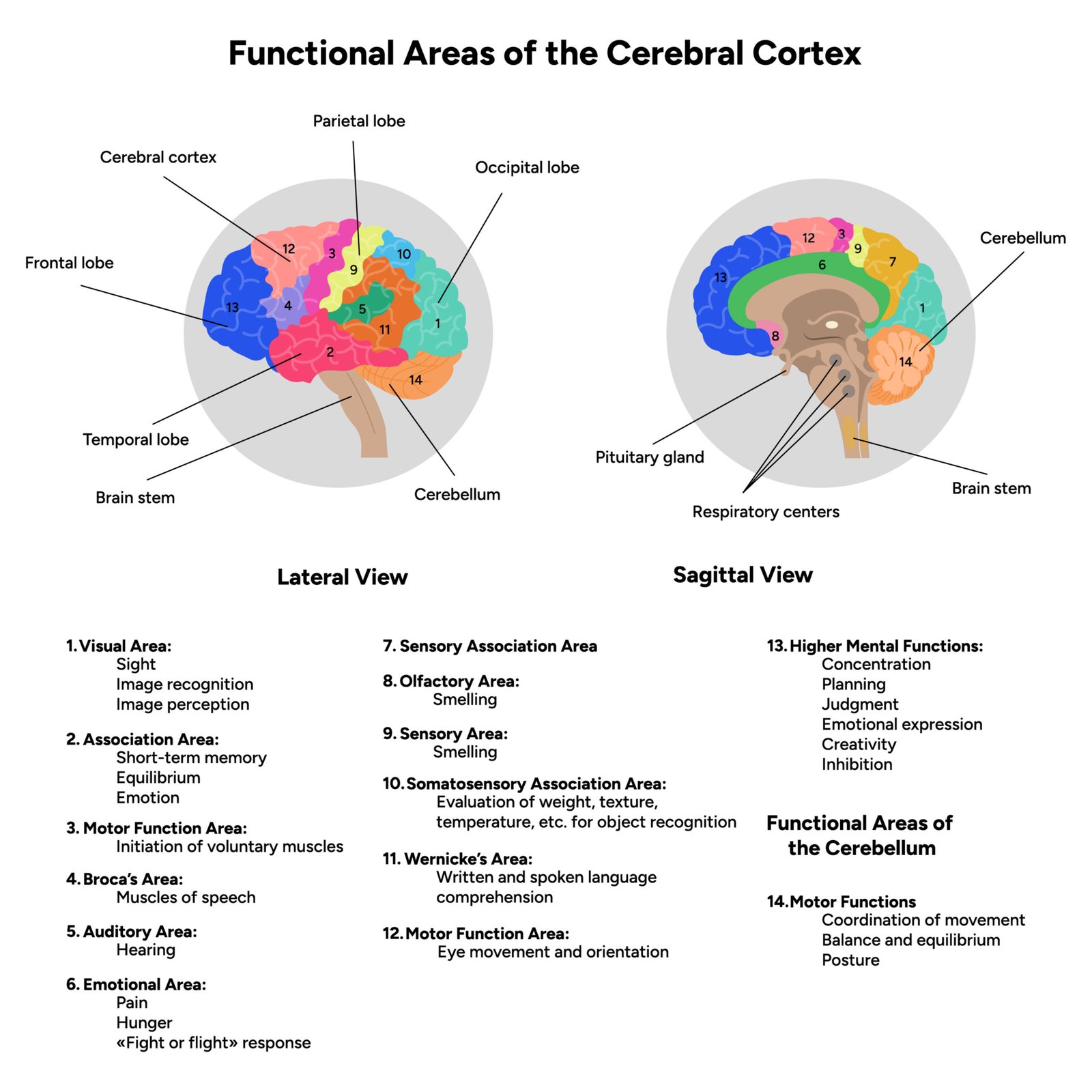
The brain delivers various mental functions but also unifies them into one whole, the character structure.2 This makes it possible for the person to think, feel, and act as one on the large number of specific tasks that must be accomplished in their day-to-day live.
How does the brain create the now ?
Consciousness isn’t a direct live feed. It is a reconstructive process:
- Synchronization: For you to perceive a unified world (e.g., seeing a ball and hearing it bounce at the same time), the thalamus must synchronize electrical pulses across distant parts of the cortex.
- Prediction: Your brain is a “prediction engine”. It compares incoming sensory data with its own internal model of the world. Consciousness often focuses on the mismatch—the things that don’t fit our expectations.
- Memory Integration: The hippocampus and prefrontal cortex work together to “time stamp” these experiences, turning a series of snapshots into a linear, coherent narrative of your life.
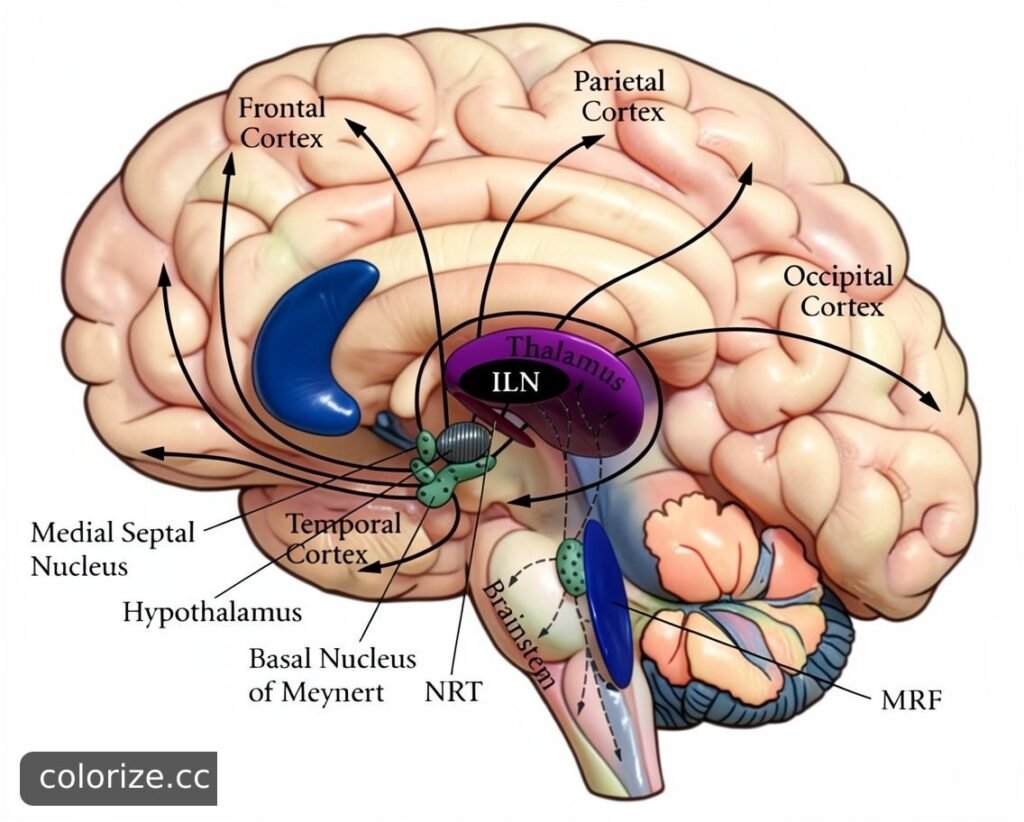
The original uploader was Fmorm, CC BY-SA 3.0, via Wikimedia Commons, colorized by colorize.cc.
The brain creates a sense of Now not through a passive camera-like feed, but through a complex, active reconstructive process. This phenomenon is rooted in the way different brain regions coordinate to turn chaotic sensory input into a smooth, unified experience.
1. Synchronization: Building a Unified World
Sensory information travels at different speeds—light reaches your eyes faster than sound reaches your ears. To perceive them as happening simultaneously (like seeing a ball hit the ground and hearing the bounce), the thalamus acts as a central hub. It synchronizes electrical oscillations across the cerebral cortex. This “temporal binding” ensures that various features (color, shape, sound, and movement) are fused into a single, coherent moment of awareness.
2. Prediction: The Brain as a Prediction Engine
Neuroscience suggests the brain is a predictive processor. Rather than waiting for data to arrive, it uses an internal model to guess what will happen next.
- Focus on Mismatch: We often don’t consciously notice things that match our expectations.
- Prediction Error: Conscious attention is primarily triggered when there is a “mismatch” or prediction error between our internal model and actual sensory input. This signals the brain to update its model and learn from the new information.
3. Memory Integration: Creating the Narrative
The sense of flow in our lives comes from how we store these processed moments.
- Time-Stamping: The hippocampus and prefrontal cortex collaborate to index and “time-stamp” experiences.
- Linear Narrative: By linking these discrete snapshots together, the brain constructs a linear, chronological story of our existence, allowing us to feel as though we are moving through time rather than experiencing isolated flashes of reality.
Sources:
1 FUNDAMENTALS OF COGNITIVE NEUROSCIENCE 2e Nicole M. Gage, Bernard J. Baars, Editors, 2018 Elsevier Inc.
2 Nathaly Branden, The Psychology of Self-Esteem.
3. A review of the sufficient conditions for consciousness, Neuroscience & Biobehavioral Reviews Volume 177, October 2025, 106333.
4. Recurrent dynamics in the cerebral cortex: Integration of sensory evidence with stored knowledge. Proc Natl Acad Sci U S A. 2021 Aug 6.