
Locus of Control is about influencing and control—or isn’t within your control.
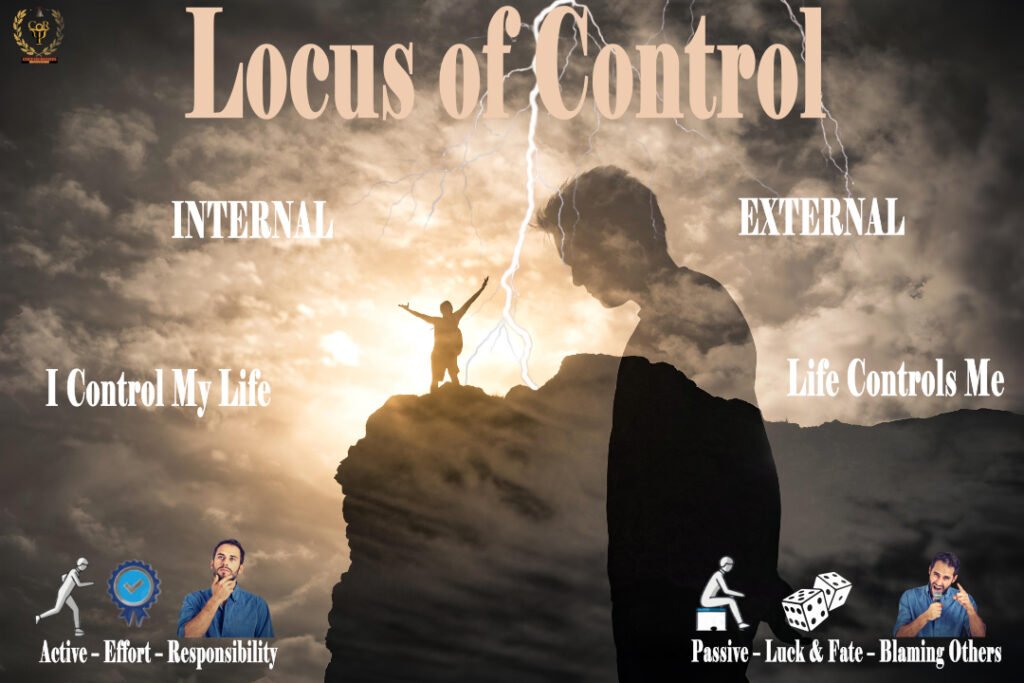
- External Locus of Control: People with an External Locus of Control go through life feeling that outcomes are mainly attributed to external factors—fate, luck, or other people determine how their days unfold.
- Internal Locus of Control: In the Internal Locus of Control style, you recognize that your actions, choices, and efforts significantly influence what happens through your own efforts and choices. This fosters a sense of personal agency.
This difference—between seeing only external forces or recognizing one’s own agency as the main driver of events—is known as the locus of control (Julian Rotter, 1966).
Julian B. Rotter wrote in 1966 a highly influential, foundational article titled “Generalized expectancies for internal versus external control of reinforcement” (Psychological Monographs: General and Applied, Volume 80, Issue 1, pages 1–28). This paper introduced the concept of Locus of Control to psychology.
Locus of control plays a major role in how we approach challenges, handle stress, work, relationships, and self-development.
Changing from an external to an internal locus of control
Crux: shifting to an internal locus of control comes down to one thing—taking action.
When you take relevant action, even small steps, you demonstrate to yourself that you can influence your circumstances. Over time, this fosters an attitude toward action. Instead of feeling stuck, you become the kind of person who takes action.

With an external locus, life feels like it’s happening to you. Fate, luck, or other people determine how their days unfold.

With an internal locus, you have power over your actions and outcomes. One can fundamentally influence what happens through one’s own efforts and choices.

An external locus can breed passivity. Those leaning toward an external focus often feel that events “happen to them,” which limits their sense of responsibility, control, and activity, resulting in greater passivity.

Internal locus fosters effort and confidence People with a strong internal locus tend to be active agents in solving problems.

An external locus can breed blaming others.

This isn’t about optimism or denial. People with a strong internal locus genuinely understand they don’t control everything. They’re honest about limits. What sets them apart is their willingness to seize opportunities when they arise and to take responsibility for the parts they can influence.
Perpetual helplessness

Perpetual helplessness is a detrimental mindset in which individuals perceive themselves as unable to change negative circumstances.
A sense of perpetual helplessness arises when repeated experiences of perceived failure or uncontrollable stress lead someone to conclude they have no power to change the situation. This leads to passivity and a tendency to remain stuck in the victim role instead of making a plan to escape the crisis.
Handling stress
Generally, people with an internal locus of control handle stress better, engage in healthier behaviors, and perform well academically or professionally because they seek solutions and are willing to persist through obstacles rather than feeling helpless. This latter tendency can lead to depression, anxiety, and a sense of passivity toward life goals.
How do you break the Cycle?
Transitioning from an external to an internal locus of control enables individuals to reclaim their agency. By initiating with small, targeted actions, they experience that these can accumulate into real changes.
Example: Sarah (Career Pivot)
A high school teacher who wanted to become a software engineer. Instead of quitting her job, she committed to coding for two hours every night after her kids went to bed. After six months, her effort proved to her that she was capable of learning this skill, which gave her the confidence to eventually apply for a coding bootcamp and land a junior developer role.
Example: Marcus (Health transformation)
A man who was 100 pounds overweight and felt intimidated by the gym. His first “effort” wasn’t a workout; it was simply driving to the gym parking lot, sitting there for five minutes, and driving home. Once that felt easy, he walked in and used one machine. By proving to himself he could “show up,” he stripped away the fear of the environment, and after adopting his diet, he eventually lost the weight over two years.
Motivation and Achievement
When you recognize that your efforts have an impact, you’re more inclined to keep going despite setbacks, actively address problems, and refine your strategies until you succeed.
Example: David (Financial turnaround)
A father in deep credit card debt who felt hopeless. He didn’t try to pay it all off at once. Instead, he focused on tracking every single penny spent for 30 days. Seeing exactly where the money went gave him a sense of “agency.” That small feeling of control motivated him to cut one expense, then another, until he had a functional budget that cleared his debt in three years.
Attitude in Relationships

People who use their ability to influence conflicts in relationships often communicate proactively and take responsibility for their part, instead of viewing problems as unstoppable external forces.
Example 1: Sam and Alex
Sam and Alex, who would go 48 hours without speaking after a disagreement about the laundry.
The External Trap: Sam believed the silence was a “test” of who cared more. He waited for Alex to break first, feeling like the relationship’s temperature was entirely out of his hands.
The Internal Shift: Sam tried a 5-Minute Reset. After an argument, he’d set a timer. When it went off, he had to offer a “peace pipe” (usually a cup of tea) regardless of who was “right.”
The first time he did it, the tension vanished in minutes. This tiny mastery experience over his own pride made him much more likely to problem-solve during the actual argument next time.
Example 2: Chloe and Marcus
Every year, Chloe’s birthday was a letdown because Marcus was often “bad at gifts,” forgetting to buy a gift, leaving Chloe feeling unloved and invisible.
The External Trap: Chloe’s internal narrative was, “My joy depends on Marcus’s ability not to forget to buy a gift.” If he fails, my birthday is ruined.” She was stuck in a loop of expectations vs. reality.
The Internal Shift: Chloe regained control. She stopped “dropping hints” (which Marcus never picked up anyway), and two weeks early, she sent Marcus a calendar invite with a link to a specific restaurant and a “Top 3” list of gift ideas.
On her birthday, she got exactly what she wanted. Marcus was relaxed because he didn’t feel like he was walking a tightrope, and Chloe felt celebrated.
Chloe realized that direct communication wasn’t “cheating” the romance—it was active problem-solving. She stopped feeling like a victim of his forgetfulness and started feeling like the architect of her own celebration.
Becoming aware of these contrasts shows how an internal perspective encourages proactivity, whereas an external attitude can lead to stagnation or bitterness.
Methods to Shift Toward an Internal Locus of Control

1. Reframe setbacks
Instead of calling yourself“a failure,” view setbacks as learning experiences that provide information about what does and doesn’t work, or as steps that deliver what changes are needed.
Example: Reframing a Rejection
A young writer at age 22 received a thoughtful rejection letter from an editor. Initially discouraged, she realized that the editor had actually spent significant time on the critique. She reframed the rejection as professional validation: only “real” writers get rejected. By viewing the rejection as professional correspondence rather than a personal insult, she felt empowered to continue her career as a “serious” writer.
2. Responsibility and Planning Journaling
Create a short daily journaling practice that focuses on all relevant events. Make a to-do list, organize, and prioritize your tasks.
3. Practice Active Problem-Solving
Internal brainstorming, stepping aside, taking time to think about conflicting events you are involved in.
Think about yourself calmly navigating a conflict at work, or swiftly adjusting plans when obstacles arise. The emotional storage derived from these mental rehearsals reinforces an internal locus.
Example: If you have a meeting with a difficult client you’re avoiding, imagine yourself speaking confidently and politely, while brainstorming solutions on the spot, while feeling more at ease. These quick brainstorming exercises help ease performance pressure over time.
4. Perpetual helplessness
If repeated failures create a sense of powerlessness, begin with small challenges that are sure to lead to small wins, gently building self-trust.
5. External Reality
Example 1: You cannot force a partner or friend to change their behavior.
Internal Shift: You control the boundaries you set, how you communicate your needs, and whether you stay in the situation or leave.
Example 2: An entrepreneur cannot control a sudden market crash.
Internal Shift: Instead of blaming the crash, persist with a new strategy.
6. Fear of Self-Blame
Shifting the locus of control means taking responsibility for your actions and responses, not accepting blame for circumstances beyond your control.
Example: The External Reality, a financial setback
Global economic factors cause your investments to lose value.
The Fear of Self-Blame: “I’m an idiot for investing then. I’ve ruined my family’s future.”
The Internal Shift: Separate the unpredictable market from your financial habits.
New Perspective: “I didn’t cause the market crash. I do, however, have the power to adjust my budget today, diversify my next move, and especially stay patient.”
Example: The External Reality, parenting or mentor struggles
You’ve given a child or a junior employee every tool to succeed, but they make a self-destructive choice anyway.
The Fear of Self-Blame: “I’m a bad parent/leader. If I were better, they wouldn’t have done that.”
The Internal Shift: Realize that another human’s free will is an absolute external reality.
The Pivot: “I cannot live their life for them. My job is to provide the boundaries and the love; their job is to choose.”
7. Seek accountability
Partner with people who promote proactive actions and self-agency. Collaboration emphasizes personal effort to shape outcomes.
8. Leadership and locus of control
When challenges occur—pressure builds, energy drops, or the way forward is unclear—and you observe people’s actual locus of control, it reveals who the real leaders are. Leaders who repeatedly say “there’s nothing we can do” encourage their teams to wait, withdraw, and give up responsibility. In contrast, leaders who remain calm and focus on what can be influenced teach their teams to take ownership, make decisions, and continue to progress.
When energy decreases or uncertainty arises, some leaders hesitate and wait for direction. Others respond calmly, take responsibility, make effective decisions, and lead their teams ahead. This contrast isn’t about personality; it’s a skill to be developed.