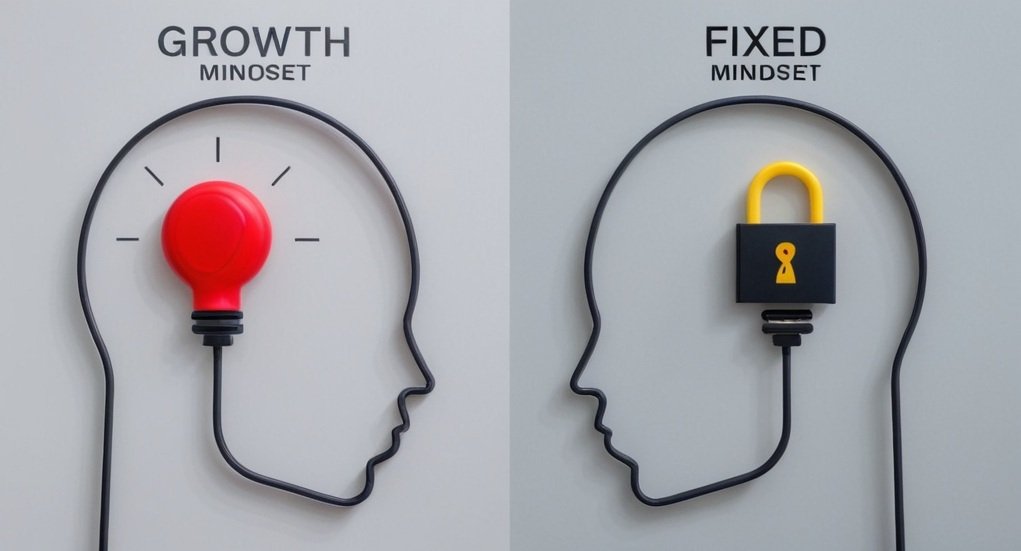
Two psychological styles
Carol Susan Dweck, a Stanford psychologist, is known for her work on motivation, personality, development, and “growth” versus “fixed” mindsets.
- Fixed Mindset: Intelligence is a fixed entity. They tend to emphasize ’performance goals’ (being better than others), leaving them vulnerable to negative feedback and likely to disengage from challenging learning opportunities.
- Growth Mindset: Intelligence is malleable. They tend to emphasize ’learning goals’ and rebound better from occasional failures.
The Self-Regulation Feedback Loop
- Most students aim to succeed on academic tests. Yet, there is increasing evidence that their success is influenced not only by actual ability, but also by the intelligence style and goals that they bring to the achievement situation.
- A feedback loop acts as the practical mechanism for a growth mindset, turning effort and failure into actionable data for improvement and feeding this back.
- A growth mindset uses feedback loops (reflection, feedback, iteration) to identify what didn’t work and, more importantly, what to try next.
- A feedback loop is a process in which a system’s output is used as input for future actions, creating a self-perpetuating cycle that enables continuous improvement, adjustment, or amplification.
- This is very important because the Feedback Loop is an important part of intelligence. If you lack this skill, you cannot learn from failure or adapt.
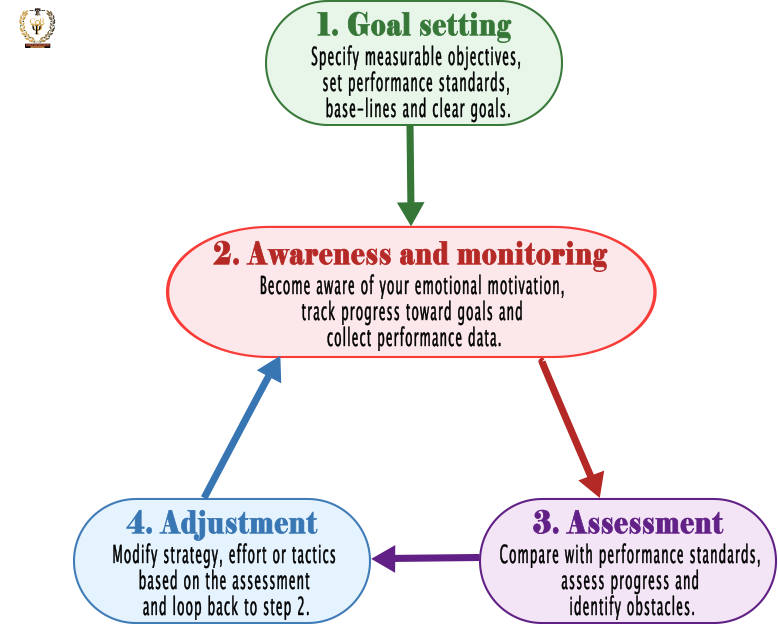
Step 1. Goal setting: Specify measurable objectives, set performance standards, base-lines and clear goals.
Step 2. Awareness and monitoring: Become aware of your emotional motivation, track progress toward goals, strategy, tactics, and collect performance data.
Step 3. Assessment: Compare with performance standards, assess progress, and identify obstacles.
Step 4. Adjustment: Modify strategy, effort or tactics based on the assessment and loop back to step 2.
Growth Mindset vs. Fixed Mindset
| Subject | Fixed Mindset | Growth Mindset |
| Motivation | A Fixed Mindset more strongly endorsed performance goals (e.g., ‘When I take a course in school, it is very important for me to validate that I am smarter than other students’). – Effort is bad. If you’re not good at something, it means you’re not “naturally talented.” Resentment to do anything extra. – Challenges are risky because they might expose your weaknesses. A reason to give up. Mistakes are always bad. | Growth Mindset more strongly endorsed learning goals (e.g., ‘It is very important to me to feel that my coursework offers me real challenges’) Growth Mindset individuals are more likely to endorse the goal of increasing ability through effort and to gravitate toward tasks that offer real challenges (‘learning goals’). There is always potential for intellectual growth; they are more willing to pursue remedial activities when they experience academic difficulty. |
| Feedback response | Fixed Mindset tends to be more concerned with outperforming others to prove their intelligence (‘performance goals’), leaving them highly vulnerable to negative feedback. They would find negative feedback to be more salient, and even threatening, to the goal of proving ability. | In a Growth Mindset, people are more accustomed to handling feedback and using it as information to adapt through a self-regulation feedback loop. |
| Learning opportunities | These individuals are more likely to shun learning opportunities they anticipate will involve a high risk of errors, or to disengage from such situations when errors occur. Indeed, when areas of weakness are exposed, they will often forgo remedial opportunities that could be critical for future success. | It Allows You to Move into New Fields. When you have a growth mindset, your past doesn’t define your future. You need to find ways to equip yourself with the skills necessary to sustain the new subject. You’re investing in your own success. |
| Blocking relevant information | A fixed mindset can lead individuals to focus on self-critical thoughts about their performance and abilities, which distracts from learning-relevant information and increases the chance of repeating those errors. | Growth Mindset, given its bias toward learning and challenge, would be more likely than Fixed Mindset to engage reactive control processes toward encoding the correct answer, thereby increasing the likelihood that they would correct their answers on a subsequent retest. |
| Resilience- the capacity to recover from and move through difficult situations. | When challenges, setbacks, and failures inevitably arise, your goal’s survival depends on your ability to persevere, learn from your failures and difficult situations, and adapt. A fixed mindset can prevent you from learning from mistakes. | By using a feedback loop, the growth mindset is more used to adjust. It Fosters Resilience. |
| Success of others | The success of others is threatening or giving envy. | The success of others are examples to learn from. |
| I | I know best. | I improve with practice. |
| Emphasis | The fixed mindset chases being “the best.” | The Growth mindset more emphasizes the growth process. |
DISCUSSION
- The Growth Mindset study aimed to understand how factors other than ability influence learning success in the face of challenges. Using this theory of intelligence to represent these factors, Carol S. Dweck and colleagues found that Growth Mindset demonstrated significantly greater overall gains in knowledge than Fixed Mindset, as it showed greater remediation of errors regardless of the confidence with which the error was initially made.
- For Growth Mindset, it was directed toward both perceptual and conceptual processing. The findings from this study are consistent with the view that fixed and growth mindsets differ in how they appraise “being better than others” and attend to learning-relevant information. To the extent that Fixed Mindset may have viewed negative feedback as a threat to self-perceptions about ability, rather than as a challenge to improve, they may have engaged less effort in ‘deep,’ semantic processing of the learning-relevant feedback, ultimately compromising their ability to correct as many errors on the subsequent retest.
- Thus, these findings complement a recent longitudinal study where a positive relationship between learning goals and final course grade was mediated by self-reported deeper processing of course material.
- Conversely, performance goals (being better than others) were negatively correlated with deeper processing and associated with poorer course outcomes.
Growth Mindset is directed toward both perceptual and conceptual processing. What does it mean?

Saying a growth mindset influences both perceptual and conceptual processing means that this type of intelligence, which supports the idea that intelligence must be developed, shapes how we interpret immediate sensory information (perceptual) and how we understand, categorize, and reason about abstract ideas (conceptual).
It is not just a positive attitude; it is a cognitive lens that influences how the brain processes, interprets, and responds to information. This is based on:
1) Increased motivation,
2) Less blockage caused by defensive actions, and
3) Increased focus on learning and the intelligence process.
Here is a breakdown of what this means:
1. Perceptual Processing (Sensory Information & Interpretation)
Perceptual processing refers to how we make sense of the world through our senses—what we see, hear, and feel in the moment.
- Reduced Threat Perception: A person with a growth mindset interprets a difficult task, mistake, or setback not as a “stop sign” or a personal failure (a threat), but as a signal that more effort or a new strategy is needed.
- Focus on Feedback: Instead of perceiving a low grade or negative feedback as “I am not smart,” the brain actively processes it as information that can be used to improve.
- Active Learning Focus: The brain is more active in processing information related to improvement and error-correction, rather than just worrying about the final result.

2. Conceptual Processing (Abstract Understanding & Knowledge)
Conceptual processing involves higher-level thinking: how we categorize, understand, and apply knowledge.
- Malleability of Ability: A growth mindset changes the concept of “intelligence” from a fixed, innate gift to a malleable skill that grows like a muscle with exercise.
- Redefining Success/Failure: The concept of “failure” is reinterpreted as a temporary, necessary part of the learning process, not a permanent definition of one’s capability.
- Strategic Thinking: It encourages conceptualizing challenges as opportunities to learn, prompting the brain to seek new, more effective strategies (e.g., trying a different approach).

How to Build a Growth Mindset
1. Embrace Challenges

View challenges as opportunities rather than obstacles. Each one is a chance to learn and grow, not a barrier to success. Start by tackling small challenges and gradually take on bigger ones as you build skills, confidence, and resilience.
2. Celebrate Effort, Not Just Success

Shift your focus from only praising outcomes to recognizing and rewarding effort. Understand that consistent effort over time is the key to mastery. Try to celebrate small victories and incremental progress, which are vital steps toward achieving larger goals.
3. Cultivate Curiosity

Stay curious and always be willing to learn. Whether reading about new science books and articles, attending workshops, or writing them yourself, new knowledge can help you continually grow and adapt.
4. Prioritize Learning Over Approval

Focus on what you can learn in every situation rather than seeking others’ approval. This perspective shift reduces fear of judgment and frees you to pursue more ambitious, innovative projects.
5. Surround Yourself with Growth-Minded People

Build a network of peers, mentors, and collaborators with a growth mindset. Their attitudes and behaviours can serve as models for you to emulate. Engaging with people who challenge and encourage your development can accelerate your growth.
6. Use feedback as a source to learn from.

- Actively seek feedback (proactive approach) and try to diversify sources.
- Process and Understand Feedback and manage emotions: Feedback can trigger defensive reactions. Acknowledge these feelings, but separate the message from the messenger.
- Cultivate a Learning Culture: Adopt a growth mindset, engage in peer-to-peer reviews, as this fosters critical thinking and allows you to learn by evaluating others’ work.
7. Widen your horizon.
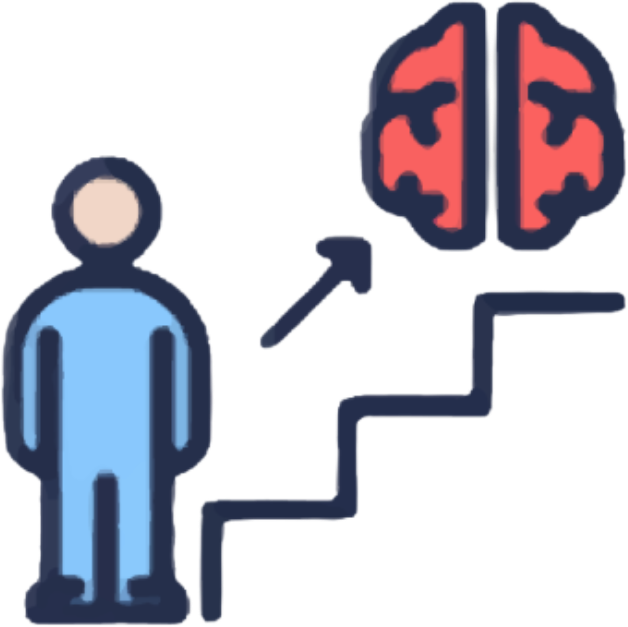
Your past doesn’t define your future, and with new knowledge or skills, you enter new fields.
Why This Matters
You don’t need to be a natural-born genius, star athlete, or entrepreneur-extraordinaire to succeed. All you need is the confidence to grow.
Here’s a truth: intelligence, talent, skills—they’re all malleable. Every time you learn, try, fail, and try again, you’re rewriting the script of what’s possible.