
Emotions may seem to be only conscious feelings, but they start as physiological responses to stimuli, pushing us away from danger toward reward. Emotional events often attain a privileged status in memory.
Cortex
The outer part of our brain consist of the cortex where our consciousness resides.
The cortex, located on the surface of the brain, contains sensory areas, motor areas and association areas (local memory) that are essential for consciousness experience. The thalamus, located in the middle of the brain, acts as a relay station and is also required for consciousness, with the interaction between the thalamus and cortex areas, in the thalamus-cortex loop. These results support the idea that the bi-directionality in the brain network is a key to identifying the location of consciousness.1
Studies have shown that activity in primary sensory areas of the brain is not sufficient to produce consciousness2: Subjects may report a lack of awareness even when areas such as the primary visual cortex show clear electrical responses to a stimulus (vision). Higher brain areas especially the prefrontal cortex that executes executive functions are necessary. There is substantial evidence that the flow of neural activity that propagates from the frontal cortex back to sensory areas is necessary for continued consciousness. (Crick, Koch 2003: A framework for consciousness)3
Theories of emotional awareness argue that circuits below the cortex, around the Amygdala, generate unconscious emotional content that is then made conscious in cortical networks involved in higher cognitive processing.4
Emotions

Emotions are generated in the limbic system below the cortex. The main emotional processing is centered around the Amygdala. The system evolved very early in mammalian evolution. In homo sapiens, it is closely linked to more recently evolved areas of the cortex such as the prefrontal cortex (executive functions).
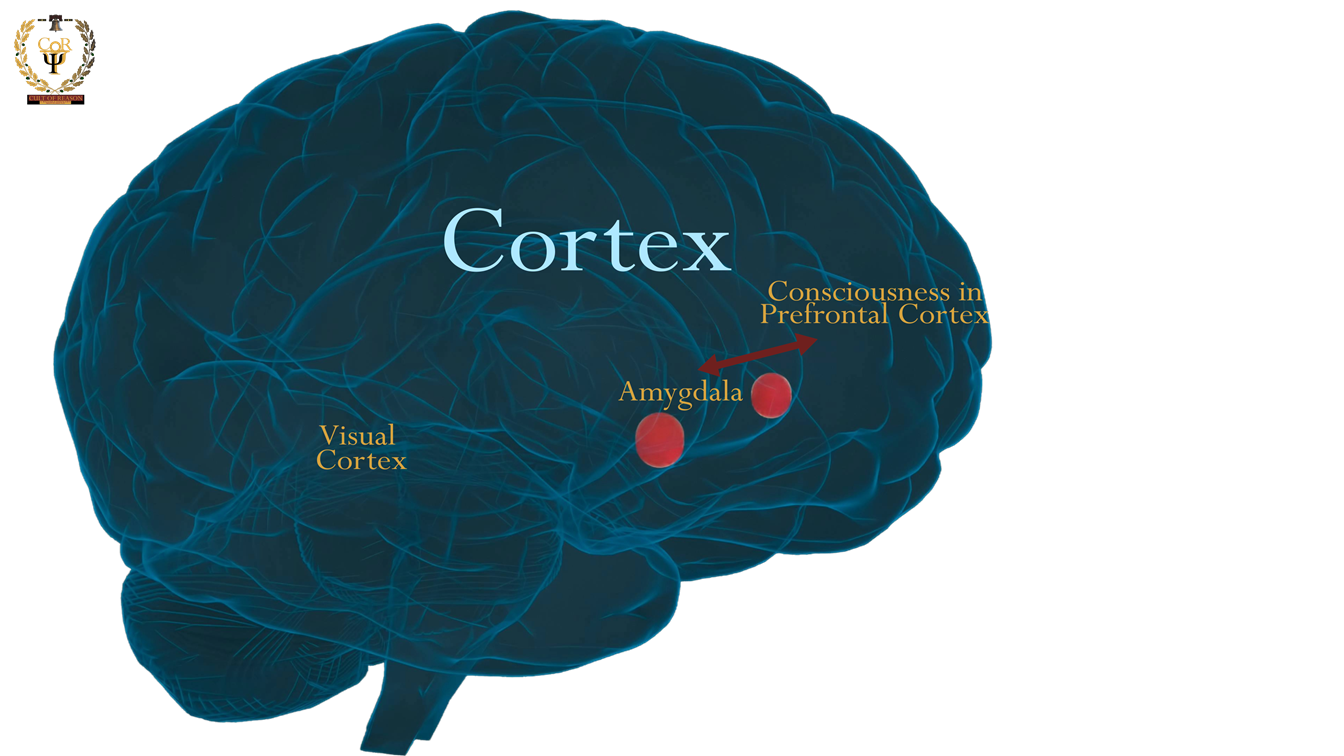
The two-way traffic between the limbic system and the cortex allows emotions to be consciously felt and conscious thoughts to influence emotions. Each emotion is produced by a different network of brain modules including hormones.
The Prefrontal Cortex (PFC)
This is where our executive functions reside: those processes that allow us to plan for the future, make decisions, and focus our attention on one thing and not another. Like a corporate executive, the PFC doesn’t do all the brain’s cognitive “work”, but rather controls and synthesizes it.5
The conscious and the unconscious route
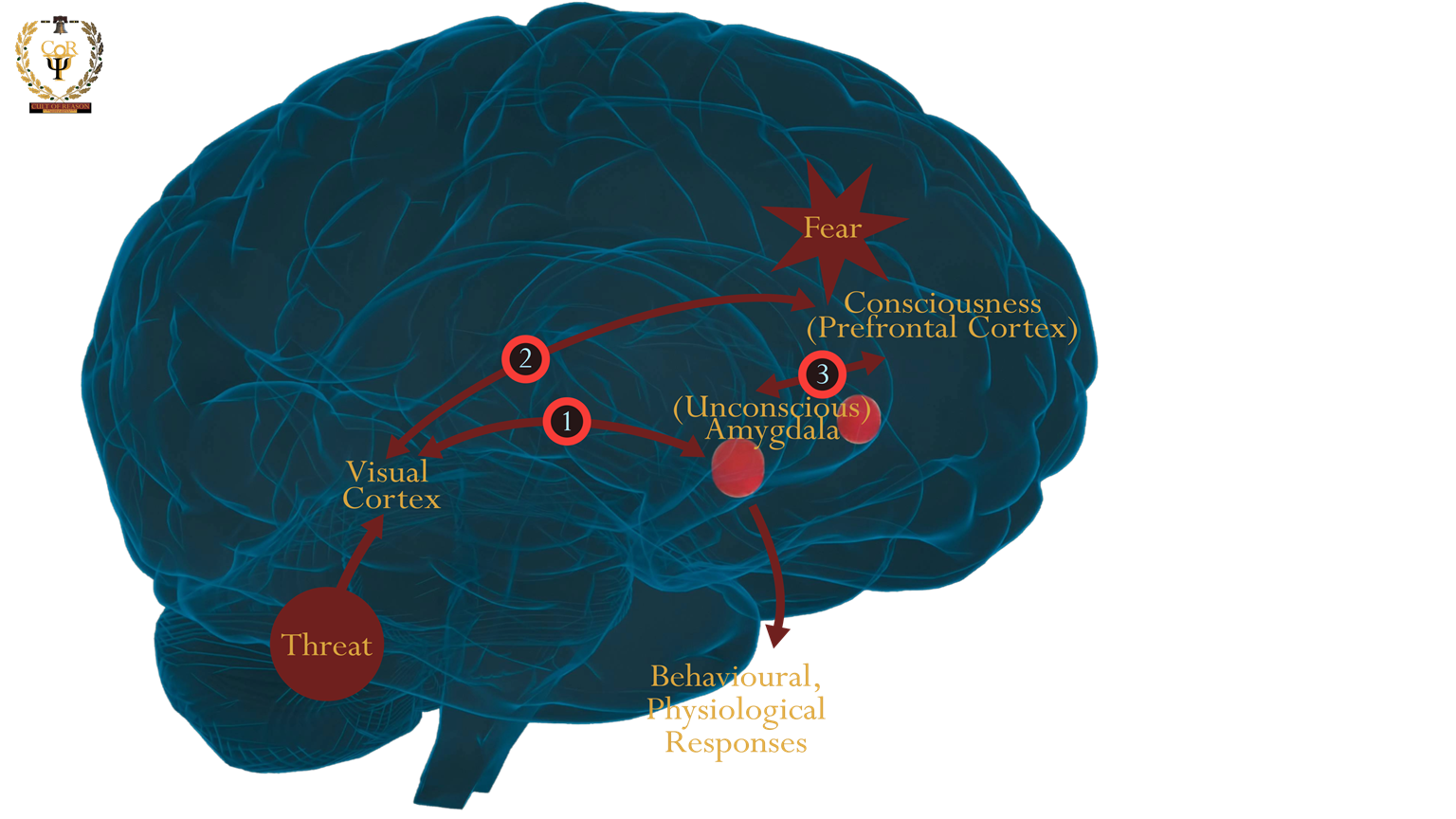
1) The amygdala picks up on emotional stimuli (here a threat) before we are aware of them. This allows us to respond much faster to a threat or reward. (The Emotional Brain, 1996 by Joseph LeDoux)
2) A second route of the emotional stimuli is simultaneously brought to the cortex areas where conscious awareness reside. The cortex is the outer part of the brain. This route takes much longer, but here you use your higher order conscious systems, such as becoming aware of your emotions, thinking, memory and language. These mental functions together with its local memory are distributed on fixed locations on this cortex according to a fixed mapping.
3) Information from the limbic system is fed to the prefrontal cortex to produce conscious feelings, while conscious knowledge about the environment is fed from the cortex back to the limbic system in a continuous loop (see the circled 3 in the figure below). The effect of emotion on thinking is stronger than the other way around, probably because there are more nerve pathways transporting signals up from the limbic system than signals transported back down.6
The amygdala is a brain structure that directly mediates aspects of emotional learning and facilitates memory operations in other regions (including the hippocampus and prefrontal cortex).
Emotional memories constitute the core of our personal history. Emotion–memory interactions occur at various stages of information processing, from the initial encoding and consolidation of memory traces to their long-term retrieval.7

Emotional arousal influences memory through the amygdala.8
The amygdala and other regions function primarily as our emotional processors and are also critical for the encoding and retrieving emotional memories. The amygdala is activated by fearful stimuli or reward. In the image below, we see how it is involved in emotional learning, neural pathway connections to other brain parts of the brain and triggering stress hormones.
Amygdala
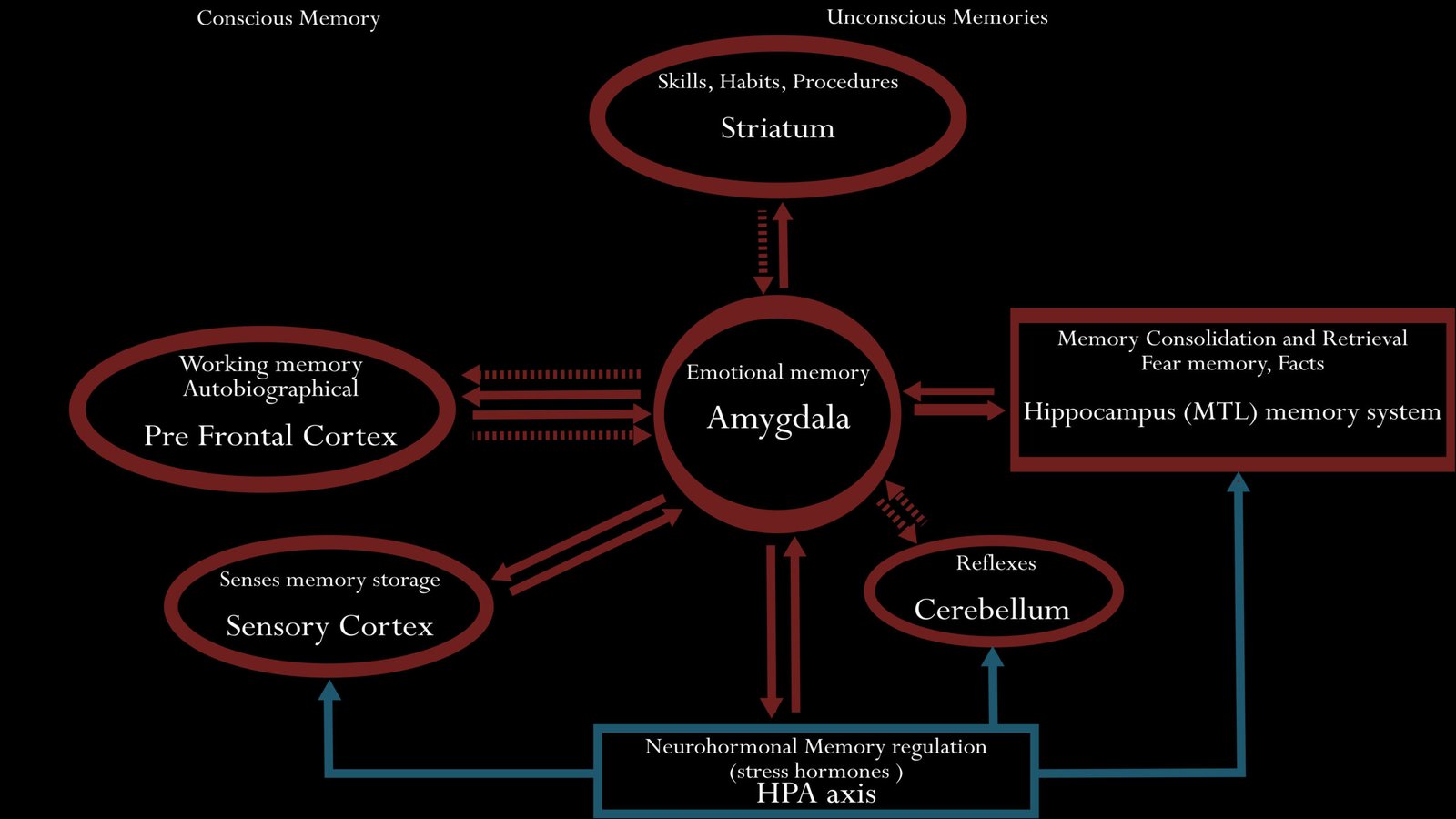

- Emotional learning takes place intrinsically in the amygdala.
- In addition to emotional learning, neural pathways to and from the Amygdala target various memory systems in the brain, including working memory, factual memory, autobiographical memory, and various other forms of memory such as skills, associative and reflex memory.
- The amygdala also triggers the release of stress hormones cortisol, reward hormone dopamine, stress reducing hormone oxytocin via the HPA (hypothalamic–pituitary–adrenal) axis pathway, which feed back onto memory consolidation and storage sites as well as the amygdala itself to enhance memory over longer periods of time. Blue arrows indicate this hormonal regulation by the HPA axis. The HPA axis is a major system that controls responses to stress and regulates digestion, immune responses, mood and emotions, sexual activity, and energy storage.
HPA axis hormones
Stress hormones, by the neuro-modulatory influence of the amygdala, have a greater effect on long-term emotional memory (by the consolidation processes in MTL memory) than for neutral events.
Stress and cortisol (stress or activity hormone) influence mood, behavior, and the sleep/wake cycle. During memory encoding, cortisol release generally enhances emotional learning and memory, but similar manipulations during retrieval diminish recall of previous memories. On tests of working memory, psychosocial stress or high cortisol doses typically worsen performance, consistent with the animal literature.
Mediating amygdala response: The amygdala is primarily activated by frightening stimuli. However, the hormone oxytocin, when secreted by the hippocampus, damps down amygdala activity and with it the feeling of fear.
Memory and Learning 9
The most important brain structures that form the major neural bases for learning, memory formation and retrieval are the cortex and the medial temporal lobes (MTL) which contains the Hippocampus.
– Autobiographical memory (events) refers to memories of conscious events in our live that have a specific source in time, space, and circumstances. Autobiographical events requires the Hippocampus and its neighboring structures to form the MTL (Medial Temporal Lobes).
For example, you remember your first kiss in the basement locker room at the senior prom with Carla Johnson whom you never saw again.
– Facts are assessed by knowing, which can be very accurate. However, they do not require active reconstruction of the original episode and can apparently be retrieved from the cortex without the aid of the MTL. When learning facts, you do not have to remember the time, place and circumstances in which you learned them.
Processing events
1. The input of the event is initially analyzed by the cortex.
2. It is integrated for memory purposes into the MTL.
3. Consolidation: the MTL then bind and integrate a number of cortical regions, a process that transforms temporary synaptic connections into longer-lasting memory traces in both the MTL and the Cortex.
The cortex is sufficient to represent repeated experiences with words, objects, people, and environments.
The Autobiographical (episodic) memory trace consists of an set of the MTL and cortical neurons, while the MTL acts as a pointer to the neural elements in cortex for the event. Retrieval occurs when a conscious cue triggers the MTL, which in turn activates that part of the cortex associated with it.
The MTL acts as a conscious apprehending of information.
Processing modes
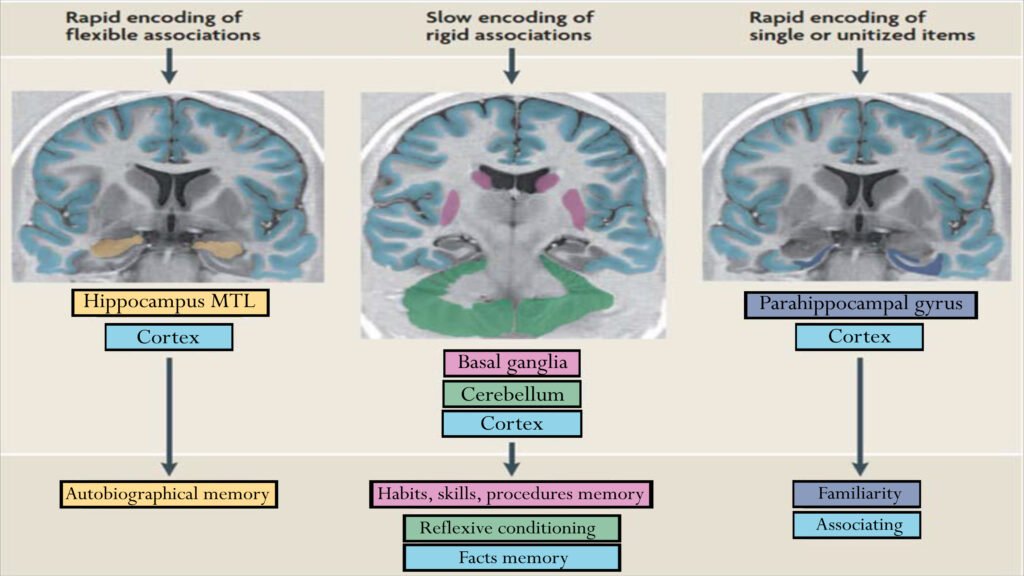
Henke (2010) 10 proposed a revised model for memory processing that is divided into three processing models, each with their own brain pathways.
According to this model:
1) Autobiographical memory involve rapid encoding of flexible associations. These memories are easily learned simply by paying attention.
2) Facts memory, procedures, and reflexes involve slow encoding of rigid associations. This is why it is so difficult to require factual knowledge. For example, you have to study very hard for exams with a lot of learning by repetition.
3) Familiarity and associative memory involve the rapid encoding of single or unitized items.
This approach to memory classes in terms of processing modes rather than their conscious or nonconscious aspects better reflects the empirical findings of the past decade.
Sources:
1 (Jun Kitazono UNIVERSITY OF TOKYO, Where Does Consciousness Reside in the Brain? 2022, scitechdaily.com)
2 Does the Prefrontal Cortex Play an Essential Role in Consciousness? Insights from Intracranial Electrical Stimulation of the Human Brain by Omri Raccah, Ned Block and Kieran C.R. Fox, page 2076 in The Journal of Neuroscience, March 10, 2021 • 41(10): pages 2076–2087.
3 Francis Crick, Christof Koch: Nature Publishing Group, neuroscience volume 6 no 2 February 2003 page 119.4 A higher-order theory of emotional consciousness by Joseph E. LeDoux and Richard Brown, E2016–E2025 | PNAS | Published online February 15, 2017, www.pnas.org/cgi/doi/10.1073/pnas.1619316114
How does the nonconscious become conscious? By Joseph E. LeDoux, R196 Current Biology 30, R191–R214, March 9, © 2020 Published by Elsevier Ltd.
5, 9 FUNDAMENTALS OF COGNITIVE NEUROSCIENCE 2e Nicole M. Gage, Bernard J. Baars, Editors, 2018 Elsevier Inc.
6 THE HUMAN BRAIN BOOK Rita Carter, THIRD EDITION 2019, THE EMOTIONAL BRAIN p126
7, 8 Cognitive neuroscience of emotional memory, LaBar and Cabeza © 2006 Nature Publishing Group.
10 Henke, K. (2010). A model for memory systems based on processing modes rather than consciousness. Nature Reviews Neuroscience, 11.