Cognitive distortions are simply ways that our mind convinces us of something that isn’t true. These inaccurate thoughts can be caused by media, a bias, or a mental block/defense that is driven by an emotion, incident, or fantasy.



Fallacies
Fallacies are forms of faulty reasoning that undermine the logical soundness of arguments. They include unsubstantiated assertions that are often delivered with such conviction that they sound like proven facts, and they are frequently found in mass media such as television and newspapers. Understanding fallacies allows one to recognize them in either one’s own or others’ statements.
Informal fallacies exploit the emotional, intellectual, or psychological weaknesses of the audience. Recognizing fallacies strengthens reasoning skills by exposing the weak links between premises and conclusions, helping discern what appears true from what is true.
Examples in the mass media today include propaganda, advertisements, politics, newspaper editorials, and opinion-based news shows.

What’s driving these Cognitive Distortions?
- Ignorance, lack of knowledge
- A bias, belief, or doctrine is blocking conscious thinking and reasoning, often driven by an associated emotion, incident, or fantasy, to keep us from feeling bad about ourselves. In other words, they function as defense mechanisms.
- Cognitive distortions are involved in the onset or perpetuation of psychopathological states of depression, anxiety, irrationality, or mania.
- Psychotic, where the mental function of reality checking is weakened or absent.
- …
Common Cognitive Distortions
1 All-or-Nothing Thinking / Polarized Thinking



All-or-nothing thinking, also known as black-and-white thinking or polarized thinking, involves viewing things in absolute terms: Situations are always black or white, everything or nothing, good or bad, success or failure, us against them. You place people or situations in “either/or” categories, with no allowance for the complexity of situations.
An example of all-or-nothing thinking is dwelling on mistakes and assuming you will never be able to do well, rather than acknowledging the error, learning from it, and moving past it.
One way to overcome this cognitive distortion is to recognize that success and progress are not all-or-nothing concepts. By addressing this type of thinking, you can feel better about your progress and recognize your and others’ strengths.
2. Overgeneralization
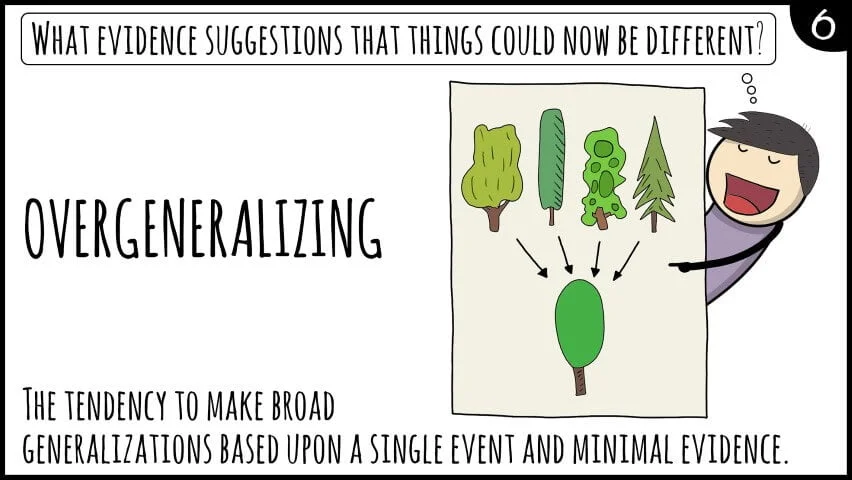
This distortion takes a single incident and generalizes it into an overall pattern.
We draw a general conclusion from a single incident or piece of evidence. If something bad happens once, we expect it to happen over and over again. A person may see a single, unpleasant event as a never-ending pattern of defeat.
3. Simplification
Preferring views that can be summarized in short soundbites, which effectively suppress complex or unconventional perspectives that require more time to explain.
4. Mental Filter



Similar to overgeneralization, the mental filter distortion focuses on a single negative piece of information and excludes all the positive ones. An example of this distortion is one partner in a romantic relationship dwelling on a single negative comment from the other and viewing the relationship as hopelessly lost, while ignoring years of positive experiences. The mental filter can foster a decidedly pessimistic view of everything around you by focusing only on the negative.
We take the negative details and magnify them while filtering out all positive aspects of a situation. For instance, a person may pick out a single, unpleasant detail and dwell on it exclusively so that their vision of reality becomes distorted.
In politics and media
Mental filtering focuses exclusively on a single negative detail while ignoring the bigger picture—it is a primary driver of polarization and biased reporting. This “tunnel vision” often occurs through the selective use of facts.
- Story Selection and Omission: News organizations often choose to cover only a handful of stories from thousands of possible events. Mental filtering occurs when outlets focus on a single scandal or failure while ignoring successes, relevance, or context.
- Media bias: Media bias often involves highlighting specific negative aspects. For example, one channel may focus exclusively on a leader’s corruption, while another focuses only on economic gains. Both present a distorted reality.
5. Spurious Correlations
The tendency to make connections where there is no true relationship is the basis of a common problem in interpreting facts: the false assumption that because two variables are correlated, one causes or leads to the other.
Spurious correlations are correlations when there is no causation.
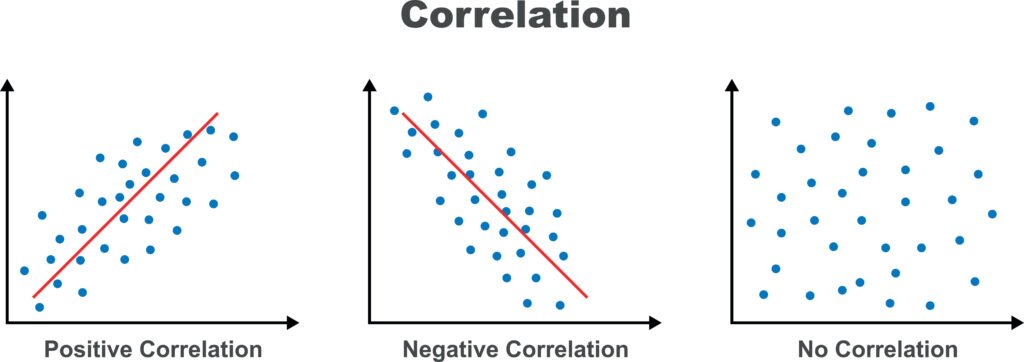
It is all too easy to view a coincidence or a complicated relationship and make false or overly simplistic assumptions in research—just as it is easy to connect two events or thoughts that occur around the same time when there are no real ties between them.
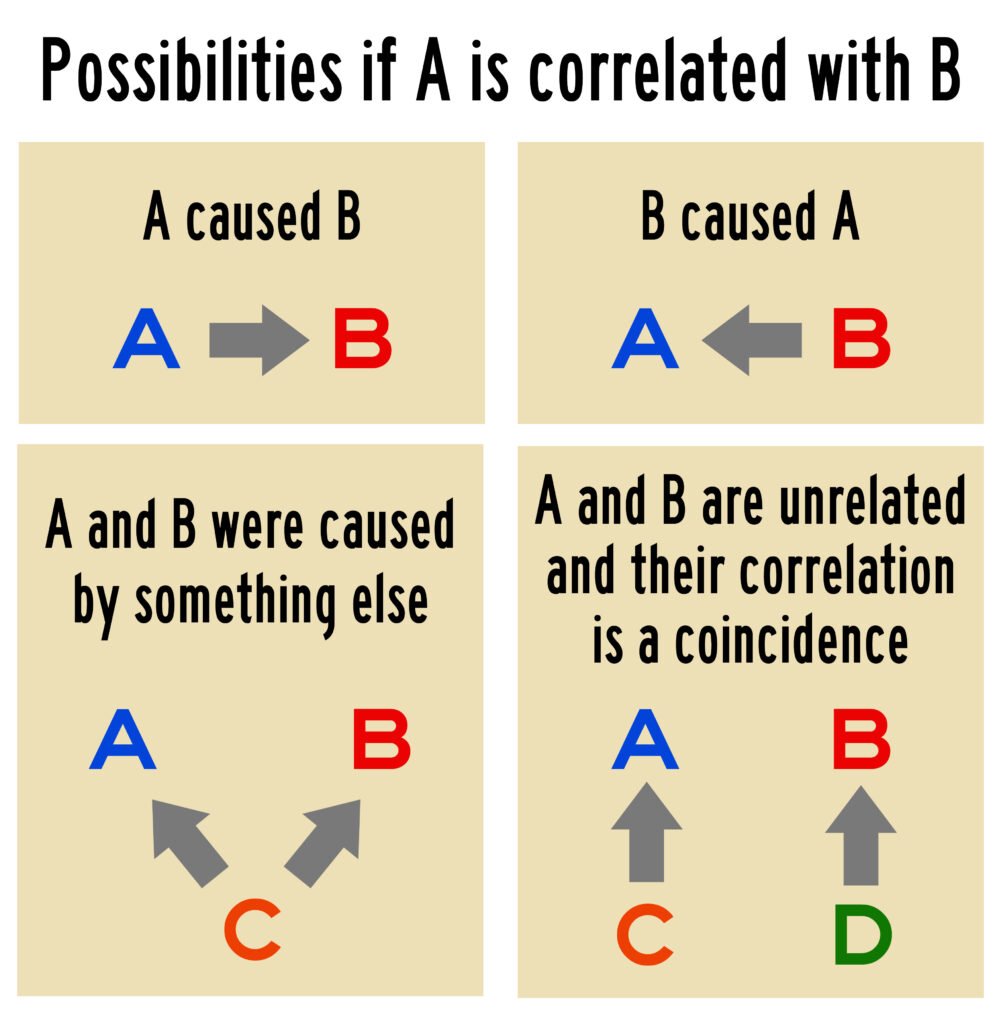
There are in fact 4 possibilities if A is correlated with B: “A caused B”, “B caused A”, “A and B were caused by something else” or “A and B are unrelated and their correlation is a pure coincidence”.
Spurious correlation example:
The correlation between the Google query “Why do I have green poop?” and the solar power generated in Bulgaria.

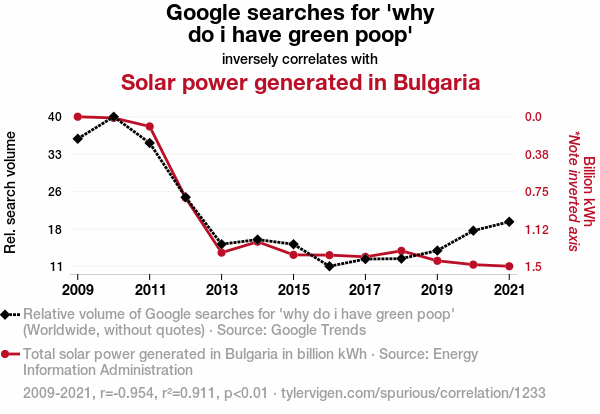
Leveraging data from Google Trends and the Energy Information Administration. Our study finds the correlation between the Google query “Why do I have green poop?” and the solar power generated in the sunny land of Bulgaria, although there is no causation between them whatsoever.
Sources:tylervigen.com/spurious-correlations, trends.google.com/trends, and eia.gov/international/data/world.
6. Magical thinking
The belief that thoughts, actions, or emotions influence unrelated situations. “If I hadn’t hoped anything bad would happen to him, he wouldn’t have gotten into an accident.”
7. Divine fallacy
Claiming that something is so extraordinary or incredible that it must be caused by a superior, divine, alien, or paranormal power.
What to do about it?
One solution is to find the links between premises and conclusions with hard evidence. Use original sources.
Causality

Causation is the basis for predictions and explanations. Causality is the relationship between causes and effects, often driven by forces or processes invisible to the naked eye.
And this unobservable connection is where magic and fantasy can operate and exist in the human brain.
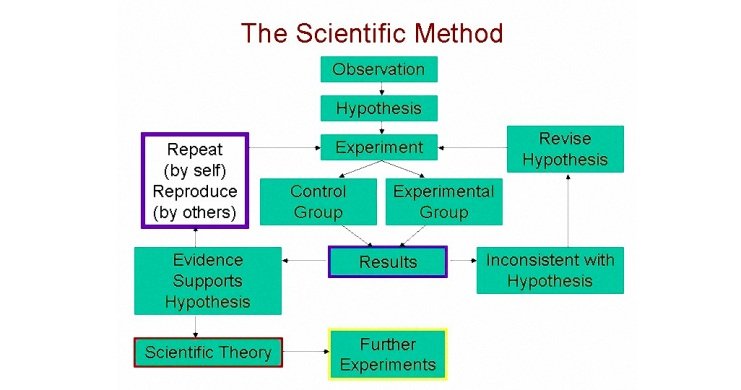
The cause should ultimately be settled by the evidence of the senses. Empirical testing remains the mark of science and is the proof of causal claims, that is scientific truth.
If a hypothesis is repeatedly and independently proven true, it constitutes a valid scientific theory or model. Here we see the Newton-Cradle. Newton’s cradle demonstrates the principles of conservation of momentum and conservation of energy.