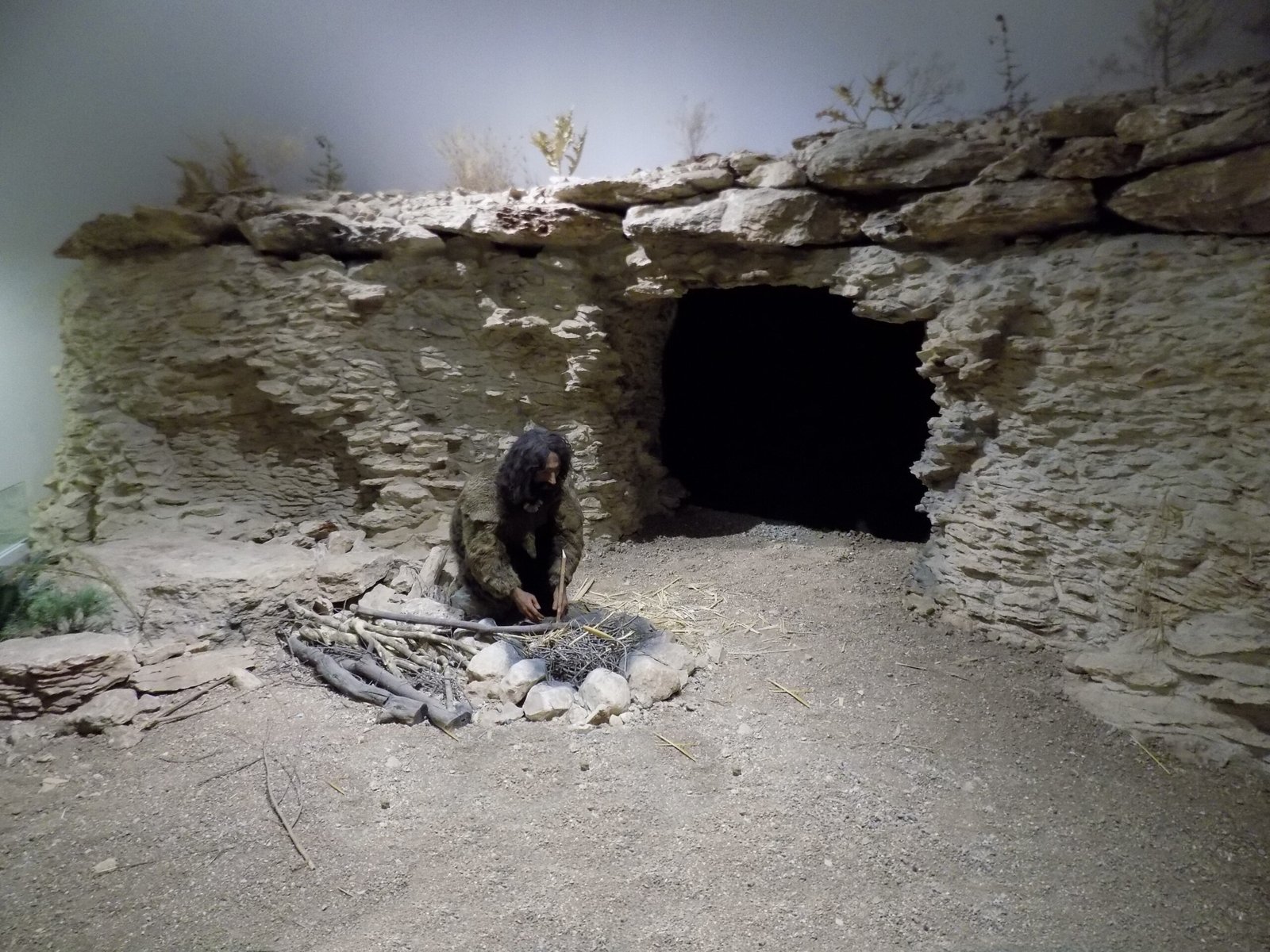
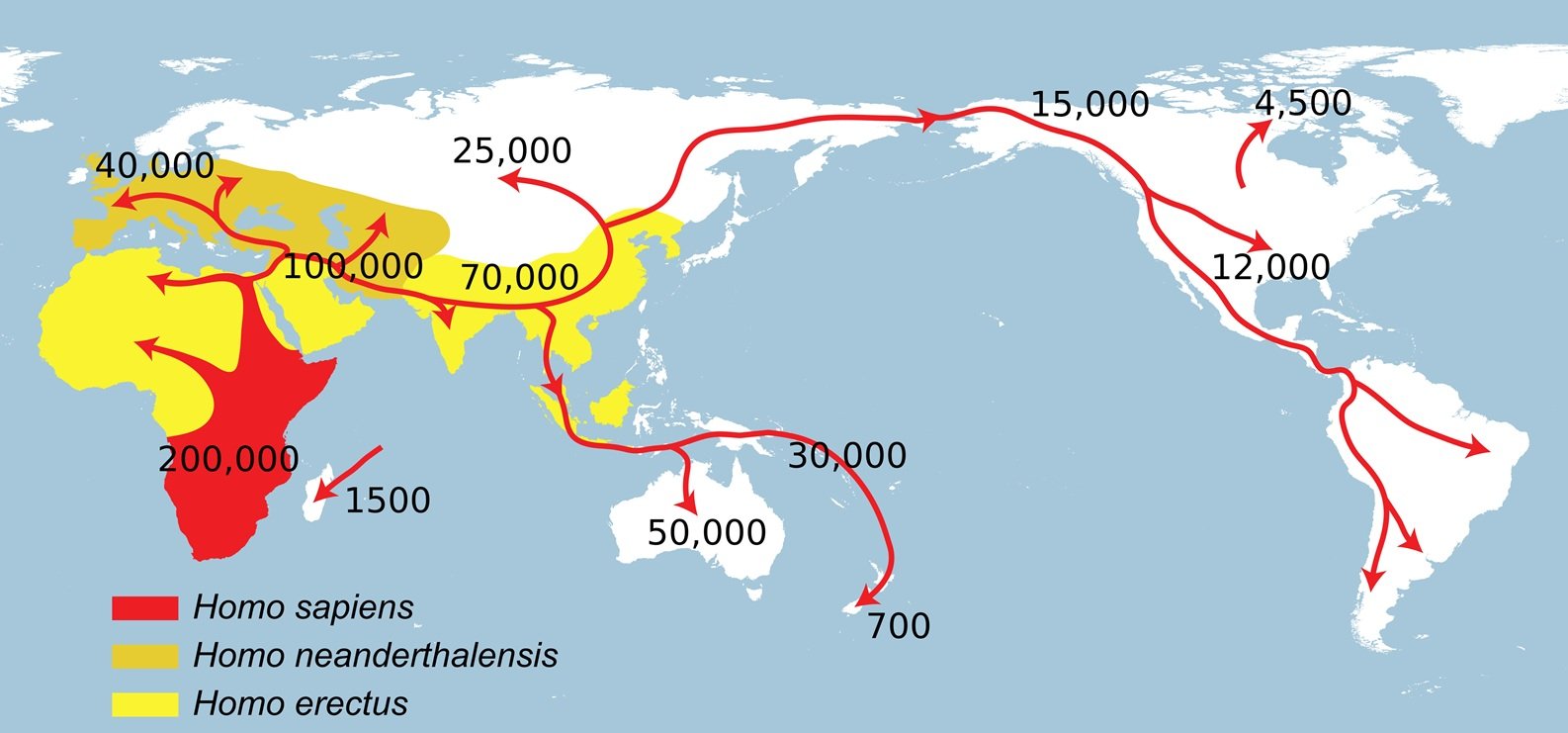
1. Spreading of Homo sapiens
- Some 100,000 years ago, during the early spread of modern Homo sapiens in the Old Stone Age, this species reached Mesopotamia. They consisted of small groups of hunter-gatherers.
- Homonim migrations begun approximately 2 million years ago with the early expansions out of Africa by the now extinct species Homo erectus. This initial migration was followed by other archaic humans including Homo heidelbergensis, which lived around 500,000 years ago and was the likely ancestor of Neanderthals as well as modern humans.
Overall, the Old Stone Age in Mesopotamia is not well documented. Geological conditions led to most remains being buried under a thick layer of sediment or submerged under the Persian Gulf’s waters. During the Middle Old Stone Age, a population of hunter-gatherers emerged, living in Zagros caves and, seasionally in open-air sites. They produced a Mousterian-type lithic industry.
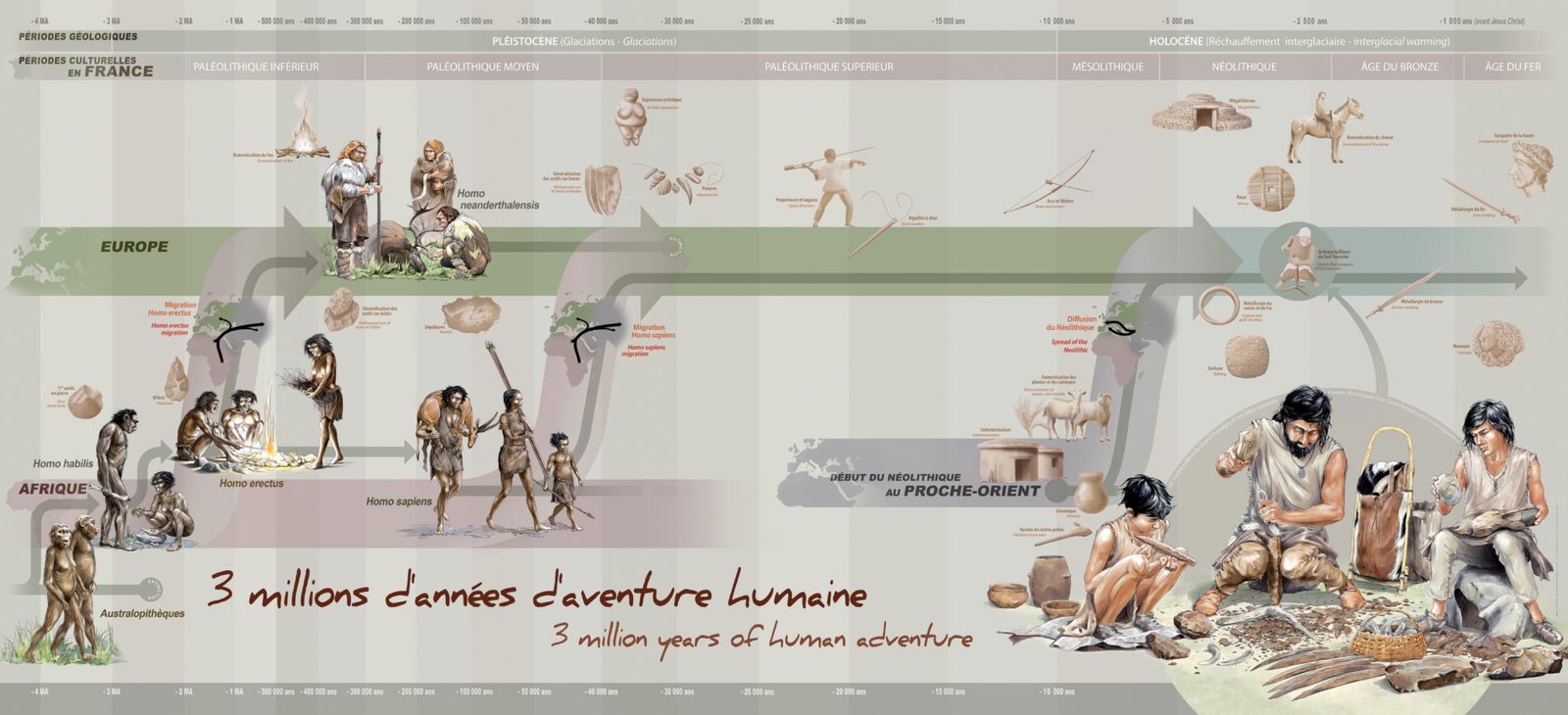
Timeline of the Old Stone Age: Prehistory museum GrandPressigny
Source: https://www.prehistory-museum-grandpressigny.co.uk/tours/self-guided-tours/, all rights reserved.

Neanderthal skeleton from the Shanidar Cave in Iraqi Kurdistan -75,000.
James Gordon from Los Angeles, California, USA, CC BY 2.0, via Wikimedia Commons.
2. Timeline Climate Change Mesopotamia
- The early rise of agriculture in Zarzian (c. -17,000 to -12,000) saw the emergence of the first temporary villages with circular permanent structures. The appearance of fixed objects, such as sandstone or granite millstones and cylindrical basalt pestles, indicated the onset of sedentarization.
- Around -15,000, during the latest stages of the Ice Age, the great reindeer herds drove north and encouraged vegetation in the warmer regions. The Persian Gulf was, at that time, actually dry land, and the Tigris and Euphrates rivers flowed into the Gulf of Oman.
- After -12,000, sea levels rose rapidly. As sea levels rose, river-borne alluvium filled the Persian Gulf, forming a vast delta that advanced gradually southward and left freshwater lakes and marshes in its wake. These thick layers of alluvium mask the archaeological record of any late Ice Age or early Holocene occupation of the lowlands of both hunter-gatherers and farmers who lived off fish and other resources in these low-lying areas for many thousands of years.
- Between -11,000 and -10,000, the earliest villages of sedentary hunter-gatherers are identified in northern Iraq. Houses are built around a family’s central hearth. The preservation of skulls of the dead and artistic activities related to birds of prey have also been uncovered.
- Around -10,000, only a third of the current surface of the Persian Gulf was covered by seawater. As a result, many Paleolithic (old stone age) sites are now located beneath the waters of the Gulf.
- Around -10,000 to -7,000, villages expanded in the Zagros and Upper Mesopotamia. The economy was mixed: hunting and the beginnings of agriculture.
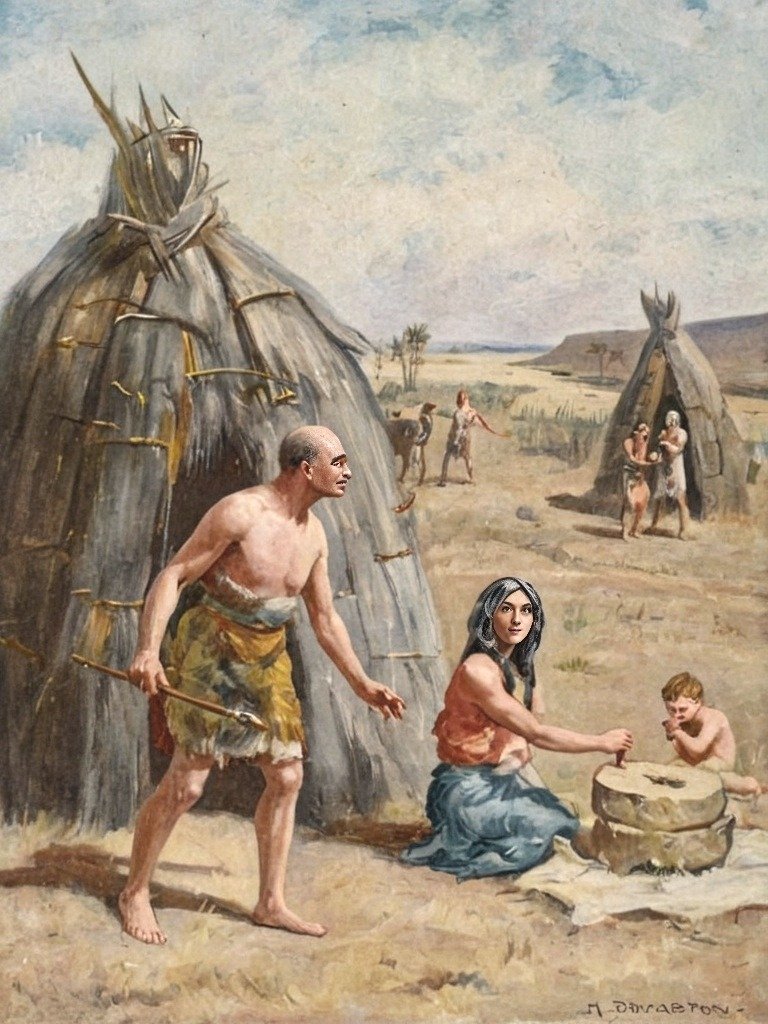
- Before -6,000, villages, each of them self-sufficient and egalitarian, supported populations of between around 50 and 200 people.
- During the Early New Stone Age (-10,000 to -7,000), communities in Southwest Asia shifted from mobile hunter-foraging to settled farming and herding. The end of the Younger Dryas brought the warmer, wetter Holocene, similar to today’s climate changes. People domesticated animals like goats, sheep, cattle, and pigs, and cultivated cereals and legumes. They built trade networks for materials like obsidian, carnelian, and seashells for tools and decoration. This resource focus led to food surpluses, supporting larger communities and new social structures based on cooperation and planning.
Source: https://journals.openedition.org/paleorient/644, The Early Neolithic of Iraqi Kurdistan.
- In southern Mesopotamia around -8,000, the Ubaid culture arose, with the oldest known site, Tell el-‘Oueili, displaying advanced architecture and irrigation. As it grew, it incorporated Halaf elements, spreading from northern Mesopotamia to southeastern Anatolia and northeastern Syria.
- Between -7,000 and -6,000, the rise of “ceramic” cultures like Hassuna, Samarra, and Halaf marked a major turning point in human history. These cultures fully adopted agriculture and animal husbandry, leading to more advanced housing. Communities started building large shared homes around central granaries, and irrigation became a key part of their farming practices. Notably, while the Samarra culture showed signs of social inequality, the Halaf culture appeared to be made up of smaller, independent groups with little hierarchy.
The female figurines, many emphasizing the breasts, womb, and genitalia, stressed the importance of the fertile mother. Many of these have been discovered in Mesopotamia, dating from between -4,000 and -5,000.

https://theiraqmuseum.com/
- As time advanced toward -4,000, villages evolved into more complex cities with developing social structure of society. A fixed elite began to emerge, gaining more influence. The most prominent centers, like Uruk and Tepe Gawra, saw the gradual rise of writing and the formation of the state, marking the end of prehistory in this region.
Source: People of the Earth, FIFTEENTH EDITION by Brian M. Fagan and Nadia Durrani, 2019.