
Self-esteem reflects the positive or negative feelings resulting from self-evaluations (judgments). It represents the overall emotions you experience after assessing your values and life rules in relation to your situation. Self-esteem includes emotional states such as triumph, despair, pride, and shame.




Self-esteem is a primal emotional state, how you feel about yourself. The brain seeks acceptable ways to satisfy a person’s needs that may conflict with the external world and with the person’s conscience (moral judgment). The conscience acts as an internal judge; it punishes the person with feelings of guilt or rewards them with feelings of pride and heightened self-esteem.


Perhaps the most eloquent testimony to the urgency of man’s need for self-respect is the terror that haunts the lives of those who fail to achieve it, the twisted paths along which that terror drives them, and the inevitable wreckage at the end (Nathaly Branden, The Psychology of Self-Esteem, 1969).

Symptoms of low self-esteem
- Bragging about oneself and denigrating others. Trying, in vain, to pump up the self-esteem.
- Fishing for compliments all the time. Trying, in vain, to pump up the self-esteem.
- Being too dependent on others’ opinions. Lack of personal internalized values. (Reasoning is blocked and/or the cortex is not well developed. No interest in truth. Feeling attacked when asked about adherence to internal values leads to lower self-esteem. This feeling of being attacked leads to more stress.)
- Living negatively and defensively. When you have low self-esteem, you can’t handle a perceived attack on your already low self-esteem and, depending on your defensive constellation, will respond. It’s a vicious circle. You feel bad and take destructive action against yourself and/or others. Now you feel even worse about yourself. To get out of this cycle, you have to strengthen your internal values and identity, and adapt your defenses and actions constructively. Improve your Self-efficacy.
A vicious circle of low self-esteem Loop
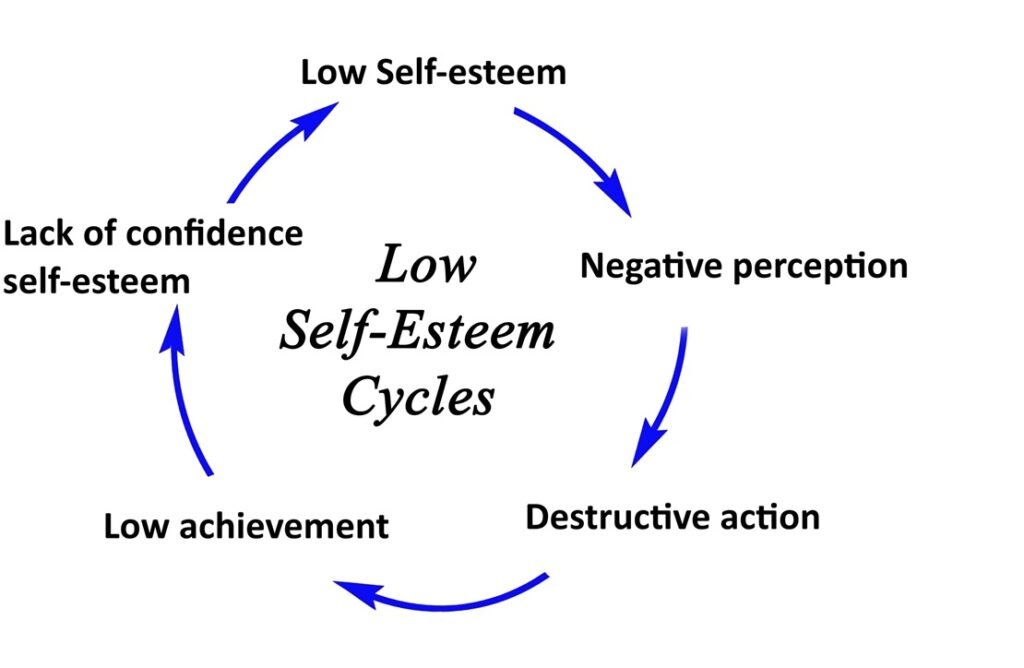
1 You feel bad and have low self-esteem.
2 Have a negative perception of yourself and others.
3 Take destructive action against yourself and/or others.
4 Low achievement and/or unhappy relationship
5 lack of self-confidence, lower self-esteem, and you feel now even worse about yourself.
6 Back to step 1.
Vicious Loop in destructive relationship
Low self-esteem in destructive relationships creates a self-perpetuating, vicious cycle. The person with low self-esteem often feels unworthy of love but cannot live alone, which leads to behaviours that keep them stuck with an abusive partner, whose actions further erode their self-worth.
- Low Self-Esteem
- Accepts/Tolerates Mistreatment (cannot live alone)
- Attempts to Control or Please (fearing abandonment)
- Partner Reacts Negatively (due to toxic dynamic and aggression)
- Lowered Self-Esteem (due to further abuse/neglect)
- Back to Step 1.
How can you build your self-esteem and confidence?


- Increase your personal identity. A strong sense of individual identity is the product of two things: a policy of independent, non-defensive thinking, and the possession of an integrated set of values. Those values must be felt internally and not taken from the slogans and doctrines of popular social organizations. When you develop and follow your internal values, you begin to like yourself, which increases your self-esteem.



- – Alter your defensive attitude and adapt your mental defenses.
- – Work on and increase your self-efficacy and efficiency
- – By preparing well for relevant, predictable, and controllable events, your confidence will skyrocket.
- – Commit to events with high subjective value/priority (discipline)
- – Change your locus of control from external to internal so you take responsibility for your own actions.
- – By lowering your defenses, you become open to relevant challenges. Take them.
- – Construct a constructive attitude and lifestyle where optimism and hope can live.
- – Depending on the attitudes of the people, social support can help you feel better about yourself.
- – Self-esteem is the key to man’s motivation.
High self-esteem Loop
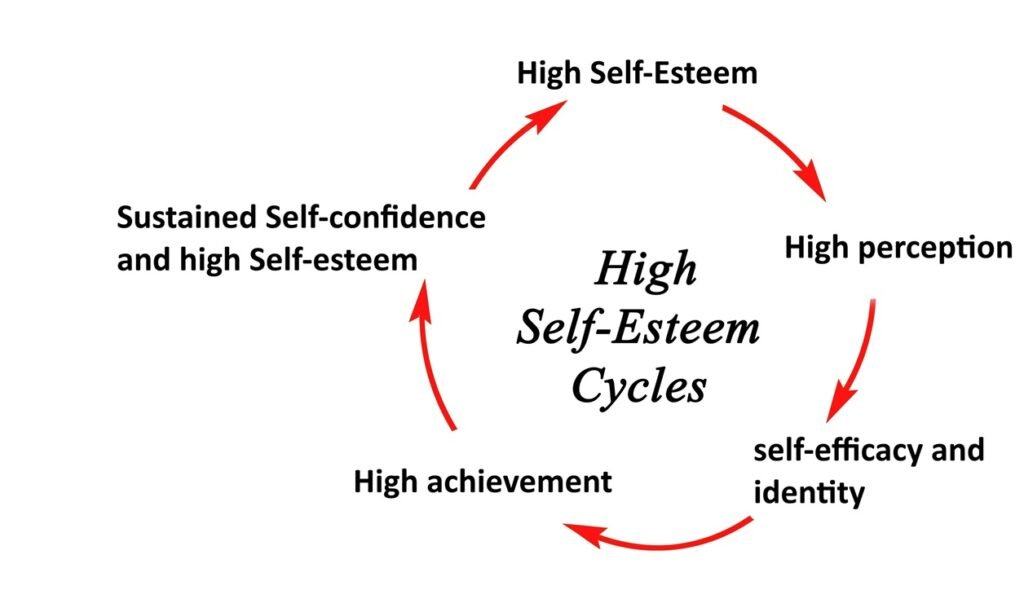
1 High self-esteem and confidence
2 High perception of yourself and (some) others
3 Use self-efficacy and identity
4 High achievement
5 Sustained self-confidence and high self-esteem
6 Back to step 1.
What are the driving forces behind low self-esteem?
Low self-esteem is rarely caused by a single event; instead, it is driven by a complex interplay of early life experiences, current life stressors, and internal cognitive patterns.
1. Early Life Experiences
- Rejecting or Neglectful Parenting who are uninvolved can lead children to believe they are unimportant or “not good enough”.
- Abuse and Trauma often cause survivors to internalize feelings of shame and guilt, mistakenly blaming themselves for the events.
- Persistent struggles in school without adequate support can lead to a deep-seated belief of being “defective” or less intelligent than peers.
2. Social and Cultural Pressures
- Bullying and Rejection—especially during identity-forming years—can severely erode one’s sense of self-worth.
- Constantly measuring oneself against the “filtered” lives of others on social media often results in feelings of inadequacy.
- Unrealistic beauty standards or intense pressure to achieve financial success can create a perpetual sense of failure.
3. Internal Cognitive Patterns
- Core Beliefs (e.g., “I am worthless” or “The world sucks” ) formed in childhood that act as a lens through which all current experiences are filtered.
- Perfectionism by setting impossibly high standards for oneself ensures constant disappointment, reinforcing the idea that one is “never enough”.
- Severe internal criticism and negative self-talk can turn temporary setbacks into permanent identity flaws.
4. Current Life Stressors
- Relationship & Work Issues, like workplace bullying, can suddenly drop even previously healthy self-esteem.
- Dealing with chronic illness, disability, or conditions like depression can limit one’s sense of agency and capability
What will happen if a person fails to get Self-Esteem?
If a person fails to develop self-esteem, the result is fear, insecurity, and self-doubt. In varying degrees of intensity, the experience of such fear is the lot of many people.
They are aware only of a desperate desire to feel confident and in control, and to feel in some way that they are good. But the cause of that discomfort and failure will haunt them for the rest of their lives. Those who fail to get a significant degree of self-esteem will strive to fake it—to escape the lack of it and seek protection from their state of inner dread behind the barricade of a pseudo-self-esteem (Nathaly Branden, The Psychology of Self-Esteem, 1969).
The extent to which a man lacks self-esteem is the extent to which emotional defenses constitute the building-blocks of his emotional emptiness.

No evasion, defenses, or self-deception can substitute for true self-esteem. A sense of efficacy and virtue cannot be bought through self-deception.
Man needs the conviction that he is fit for reality, respects truth, and has internalized personal and social values.
Self-esteem is earned through the fullest exercise of one’s heart and intellect, by abandoning submission to outdated faith and looking at what is really true, resulting in knowledge and perseverance. Effectiveness is attained, not only by thinking, but by abandoning conformity; Happiness consists of gaining love of oneself and people dear to us.
A key to mental health is awareness of one’s defenses, motives, and conflicts. The most basic function of self-consciousness is awareness of the thinking processes and how they are influenced. Individuals with high levels of insight know how they feel, what drives them, when and why they have conflicts, and what they need to feel fulfilled. Individuals with poor insight engage in mental defenses like denial, and either are clueless about who they are or try to convince themselves they are something they are not.

Pseudo-self-esteem
Pseudo-self-esteem is an irrational pretense at self-value, it is a non-rational, self-protective device to diminish anxiety and to create a false sense of security —to satisfy a need for self-worth while allowing the real causes of its lack to be evaded.
A man’s pseudo-self-esteem is maintained by two means, essentially:
- By blocking, evading, repression, rationalizing and otherwise denying ideas and feelings that lower the self-esteem;
- By seeking some alternative value or virtue which he experiences as less demanding or more easily attainable.
This complex process of self-deception, holds the key to his lack of motivation, values and lack of goals.
To deal with life’s opportunities, challenges and dangers, the method to deal with them is on values, intelligence and getting things done, but first you have to get rid of defenses, blockages that block any action.
Fear dominates this man’s psychology, impairing his perception, skewing his judgments, and motivating his actions. It restricts his intellectual pursuits and compels him to make increasingly justifications. Fear hampers his ability to develop normally, stalls his growth, and steers him toward goals that favor passive conformity.