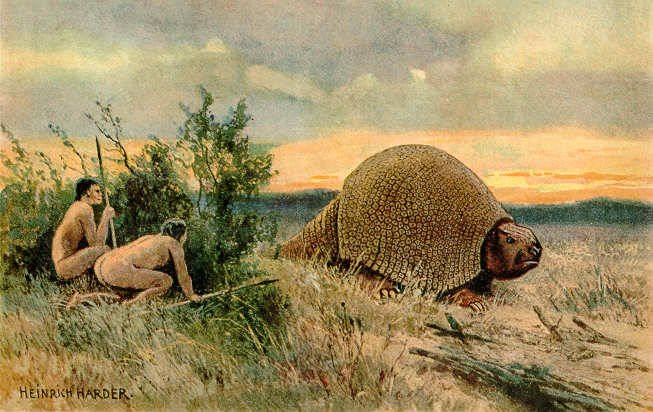
Human evolution
The study of human evolution embraces many subject areas that at first glance appear only tangentially related. Yet one cannot hope to understand our past without reference to the biotic and physical context out of which, and within which, our evolution has taken place. So this science is a multidiscipline of geology, primatology, systematics, evolutionary theory, and genetics as with the fossil and archaeological records themselves.
Paleoanthropology is defined as this multidisciplinary branch of science that focuses on the evolution and prehistory of the species Homo sapiens and its extinct relatives through the study of fossil records and artifacts.
We first find primates in the fossil record ca. 65 millions of years ago (Ma).
Prehistory
Prehistory, also called pre-literary history, is the period of human history between the first known use of stone tools by hominins c. 3.3 million years ago and the beginning of recorded history with the invention of writing systems.
Humans evolved in Africa through the lineage of hominins, which arose 7–5 million years ago. The ability to walk on two legs emerged after a split into such as Australopithecus. “Lucy” is the first, and only up until now, Australopithecus afarensis fossilised skeleton found. She was only 1.06 m (3 ft 6 in) tall.
Old Stone age
Hominins began to use rudimentary stone tools c. 3.3 million years ago, marking the advent of the Old Stone (Palaeolithic) age. The Paleolithic Age is the earliest stage of human development where organized societal structures are known to have existed. These social structures consisted of people living in bands which survived by hunting and gathering food. They used fire going back some 500,000 years ago, and increasing sophistication of stone tools, jewelry, cave paintings, and religious cult symbols during this period.
Ancestors
Homo habilis → Homo ergaster / Homo erectus (→ Homo antecessor)? → Homo heidelbergensis → archaic Homo sapiens → Homo sapiens
Such ancestors are known only through their fossilised remains, stone tools, broken bones, carved figurines and other left-overs.
Early Paleolithic (old stone) Age
During the Early Paleolithic Age, hominins grouped together in small societies such as bands and subsisted by gathering plants, fishing, and hunting or scavenging wild animals using knapped stone tools.
(The genus Homo evolved from Australopithecus.[8] )
The earliest record of Homo is the 2.8 million-year-old specimen LD 350-1 from Ethiopia,[9] and the earliest named species is Homo habilis which evolved by 2.3 million years ago.[10]
Homo erectus[b] evolved by 2 million years ago[12][c] and was the first hominin species to leave Africa and disperse across Eurasia.[14] They lived in caves as well as open sites. These first Homo erectus made stone tools of the Oldowan type, but these were rapidly succeeded by a more complex ACHEULEAN tool kit (EARLY PALEOLITHIC) based on large bifacially flaked artifacts, such as handaxes and cleavers.
Around 500,000 years ago, hominins began to use fire for heat and cooking.
Middle Palaeolithic (old stone) Age
Early humans
Modern humans, early Homo sapiens, evolved in Africa around 300,000 years ago (Middle Palaeolithic) and initially lived as hunter-gatherers. They migrated out of Africa during the Last Ice Age and had populated most of the Earth by the end of the Ice Age 12,000 years ago.
Initially, stone-tool-making techniques continued more or less the same as among Homo erectus, but eventually a refinement was developed, leading the way to the development of the MIDDLE PALEOLITHIC stone industries. This was the PREPARED-CORE technique, whereby a core was shaped from which a substantially
completed tool could be struck with a single blow. These early humans also provide us with the first definite evidence for the construction of shelters at open sites. These were constructed using a framework of branches embedded in postholes on the ground and tied together at the top.
Homo sapiens emerged in Africa around 300,000 years ago[d] from the species Homo heidelbergensis.[e][21] Humans continued to develop over the succeeding millennia, and by 100,000 years ago, were using jewelry and ocher to adorn the body.[22]
Late Palaeolithic (old stone) Age
By 50,000 years ago, they buried their dead, used projectile weapons, and engaged in seafaring.[23] One of the most important changes (the date of which is unknown) was the development of syntactic language (using grammar rules), which dramatically improved the human ability to communicate.[24] Signs of early artistic expression can be found in the form of cave paintings and sculptures made from ivory, stone, and bone. The earliest known musical instruments besides the human voice are bone flutes from the Swabian Jura in Germany, dated around 40,000 years old.[27] Paleolithic humans lived as hunter-gatherers and were generally nomadic.[28]
The earliest modern humans brought with them the highly sophisticated blade-based stone-working industries of the LATE PALEOLITHIC. This phase is most clearly documented in EUROPE, and is accompanied by the earliest evidence for and the emergence of engravings, sculpture, music, and elaborate body ornamentation. It was modern humans, too, who for the first time crossed into the New World (AMERICAS; PALEOINDIAN) and traversed a substantial sea barrier to reach AUSTRALIA.
Modern humans evolved from Homo sapiens, originating in Africa and the Middle East about 90,000 years ago, and appearing in Europe during the Ice Age period (40,000–35,000 BCE). During this time, humanity spread over all major land masses following the retreating glaciers of the last Ice Age at 11,000–8000 BCE.)
New Stone (Neolithic) Age
Rise of agriculture
Soon afterward, the Neolithic Revolution in West Asia brought the first systematic husbandry of plants and animals, and saw many humans transition from a nomadic life to a sedentary existence as farmers in permanent settlements. The growing complexity of human societies necessitated systems of accounting and writing.
Beginning around 10,000 BCE, the Neolithic Revolution, the New Stone Age, marked the development of agriculture, which fundamentally changed the human lifestyle.
The transition to agriculture created food surpluses that could support people not directly engaged in food production, permitting far denser populations and the creation of the first cities and states.
The growth in the NEOLITHIC period (New Stone Age) of settled village life and the DOMESTICATION of animals and plants. These developments paved the way toward COMPLEX SOCIETIES and the written word, and hence toward the end of the long period of human PREHISTORY.
Metalworking was first used in the creation of copper tools and ornaments around 6400 BCE.[49] Gold and silver soon followed, primarily for use in ornaments.[49] The first signs of bronze, an alloy of copper and tin, date to around 4500 BCE,[68] but the alloy did not become widely used until the third millennium BCE.[69]
Steven Mithen: The prehistory of the mind
Numerous studies have compared the chimpanzee and human mind, notably with regard to linguistic capacities.
Yet such studies have ultimately proved unsatisfactory, because while the chimpanzee is indeed our closest living relative, it is not very close at all. We shared a common ancestor about 6 million years ago. After that date the evolutionary lineages leading to modern apes and humans diverged. A full 6 million years of evolution therefore separates the minds of modern humans and chimpanzees.
It is that period of 6 million years which holds the key to an understanding of the modern mind. We need to look at the minds of our many ancestors during that time, including
The 4.5-millionyear-old ancestor known as Australopithecus ramidus;
The 2-million-year-old Homo habilis, among the first of our ancestors to make stone tools;
Homo erectus, the first to leave Africa 1.8 million years ago;
Homo neanderthalensis (the Neanderthals), who survived in Europe until less than 30,000 years ago;
Finally our own species, Homo sapiens sapiens, appearing 100,000 years ago. Such ancestors are known only through their fossil remains and the material residues of their behaviour- those stone tools, broken bones and carved figurines.
Ch1: A History of Public Health, from “The-New-Public-Health, 2014”
A Mesolithic Age or transitional phase of evolution from hunter–gatherer societies into the Neolithic Age of foodraising societies occurred during different periods in various parts of the world, first in the Middle East from 9000 to 8000 BCE onward, reaching Europe about 3000 BCE.
The change from hunting, fishing, and gathering modes of survival to agriculture was first evidenced by domestication of animals and then the growing of grain and root crops, and vegetables. Associated skills, including food storage and cooking, pottery, basket weaving, ovens, smelting, and trade, led to improved survival techniques and population growth gradually spread throughout the world.
Communal habitation became essential to adaptation to changing environmental conditions and hazards, allowing population growth and geographic expansion. At each stage of human biological, technological, and social evolution, humans coexisted with diseases associated with the environment and living patterns, seeking herbal and mystical treatments for the maladies. People called on the supernatural and magic to appease these forces and prevent plagues, famines, and disasters. Shamans or witch doctors attempted to remove harm by magical or religious practices along with herbal treatments acquired through trial and error. Life expectancy in prehistoric times was 25–30 years, with men living longer than women, probably due to malnutrition and maternity-related causes.
Cults (worship) in natural religions
The most important cults in natural religions, occurring in almost all religions of this group, are:
- worship of the forces of nature in the form of various spirits and later deities and god(s).
- the cult of fertility
- cult of ancestors – including the cult of the deity that protects their souls/spirits
- cult of a divine ancestor – the founder or first man of a given nationality or tribe
- solar cult , lunar cult , sometimes also the cult of other heavenly bodies
- cult of the Great Goddess – the Forefather
- Earth cult – agrarian cult
- cults of the elements – fire (often associated with the solar cult), wind, water (oceans, lakes, rivers), atmospheric phenomena – the god/goddess of thunder is usually also a military deity
- cult of animals – considered to be endowed with supernatural powers
- cult of plants – often trees or their groups – groves, forests, considered sacred or the seat of deities.
- cult of objects like stones
- the cult of heroes – warriors and leaders who, after death, were promoted to the role of deities
- cult of crafts – a common motif of the “divine blacksmith”, believers believe that some crafts were taught to their ancestors by the gods
The aim of religious cult is to experience communication with the sacred through a number of activities, such as identifying the addressee of the cult, celebrating, propitiating, giving thanks, uniting and obtaining some of the power from him. The cult achieves this by making a mythology and let the believers relive the stories by monuments, statues, painting, movies, holidays, names of people, …. A make believe of the divine mythologies.
In society, a religious cult, which defines norms of behaviour, introduces order into the lives of followers, and performs integrating, educative, educational, emotional, expressive, aesthetic and affirmative functions [3] .